A compass made of moving scenery
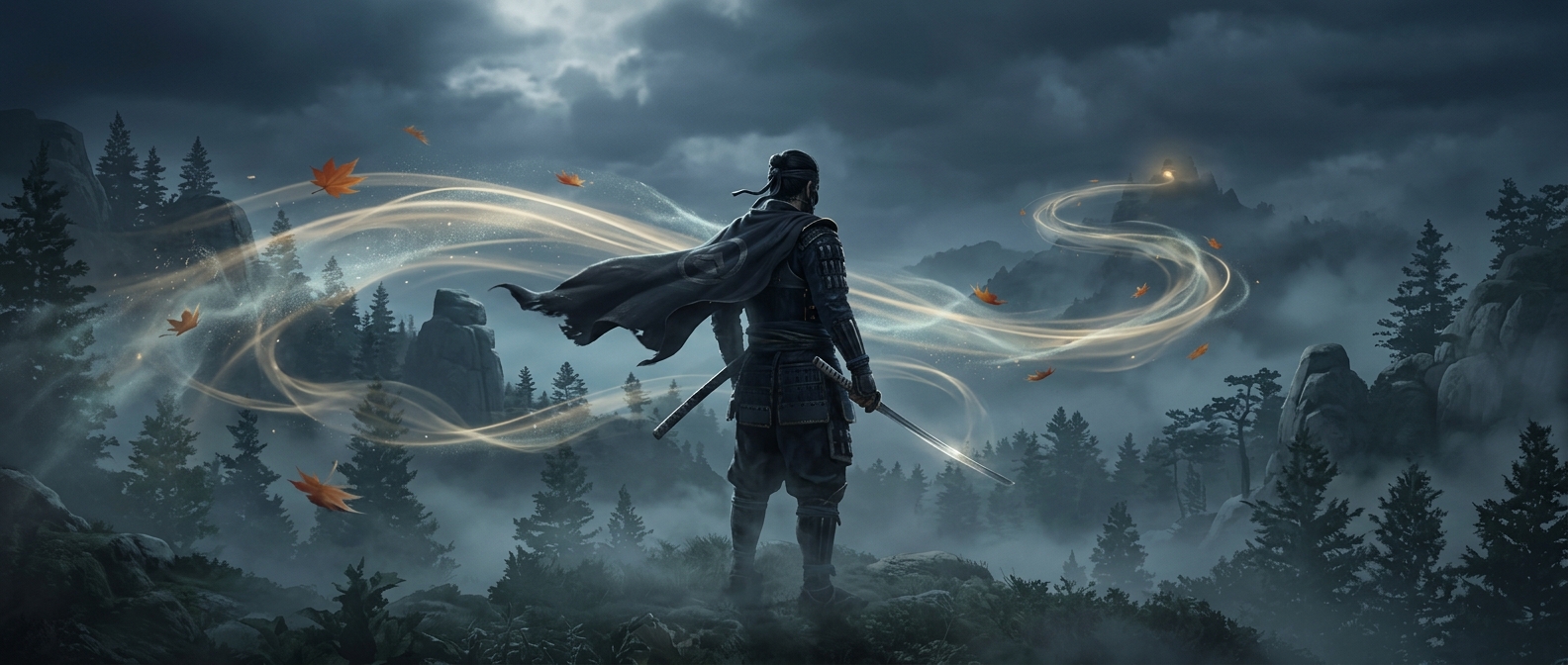
In Ghost of Tsushima, the wind is not just atmosphere. When the player chooses a destination, a gust sweeps through the landscape toward it, bending grass, stirring leaves, and tugging at parts of Jin’s clothing. The direction of that motion turns the scenery into a guide: look for what the wind is pushing, then ride or walk that way.
The gust can be summoned when needed, so it replaces the constant screen-space arrow of a typical minimap with a cue that belongs to the world. Players still choose where to go; the wind communicates the route to the selected objective rather than steering Jin automatically.
Navigation without covering the view
A minimap gives precise information, but it also asks players to keep glancing away from the landscape. The guiding wind shifts that attention back to the island itself. Instead of reading a symbol in a corner, players scan the horizon and notice motion in the grass or trees—details that also help make the open world feel alive.
That choice creates a different kind of navigation. The wind is less like a street-by-street diagram and more like a directional nudge: it points toward the goal while leaving the player to find the path through hills, forests, and other obstacles. Exploration stays active, and the scenery does double duty as both setting and interface.