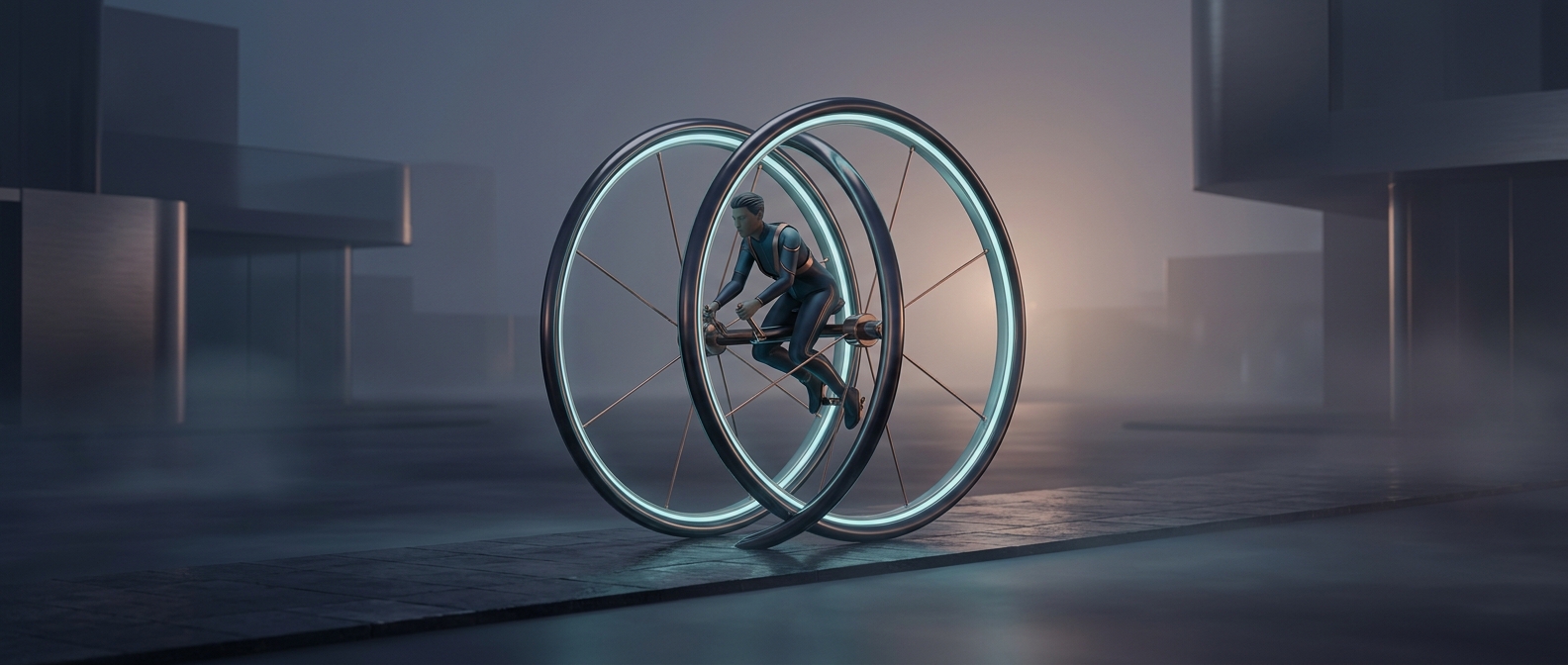
Why a Unicycle’s Pedals Keep Turning
On most unicycles, the cranks—the arms that hold the pedals—attach directly to the wheel’s axle. There is no freewheel, the one-way mechanism on many bicycles that lets the wheel keep rolling while the pedals stop. When the wheel turns, the pedals turn with it; pressing either pedal can drive the wheel forward or backward.
That direct connection makes pedaling part of balance, not just propulsion. If a rider’s body tips ahead of the wheel, a forward pedal stroke moves the wheel underneath them. If they begin to fall backward, easing off or pressing backward can shift the support point the other way. These corrections can be small, but they need to happen quickly.
Balance Is a Continuous Adjustment
A unicycle has only one tire touching the ground, so it cannot rely on a second wheel to steady it. The rider continually adjusts where that single contact point sits beneath their body. Pedaling changes that position, while hips and arms help manage side-to-side wobble.
“Constant pedaling” does not mean the rider must push hard every instant. Momentum can carry the wheel briefly, and an experienced rider may pause their effort. But the pedals cannot stop independently while the wheel coasts: they remain locked to its rotation. The practical lesson is that staying upright means keeping the wheel responsive under the body, with the feet ready to make the next correction.