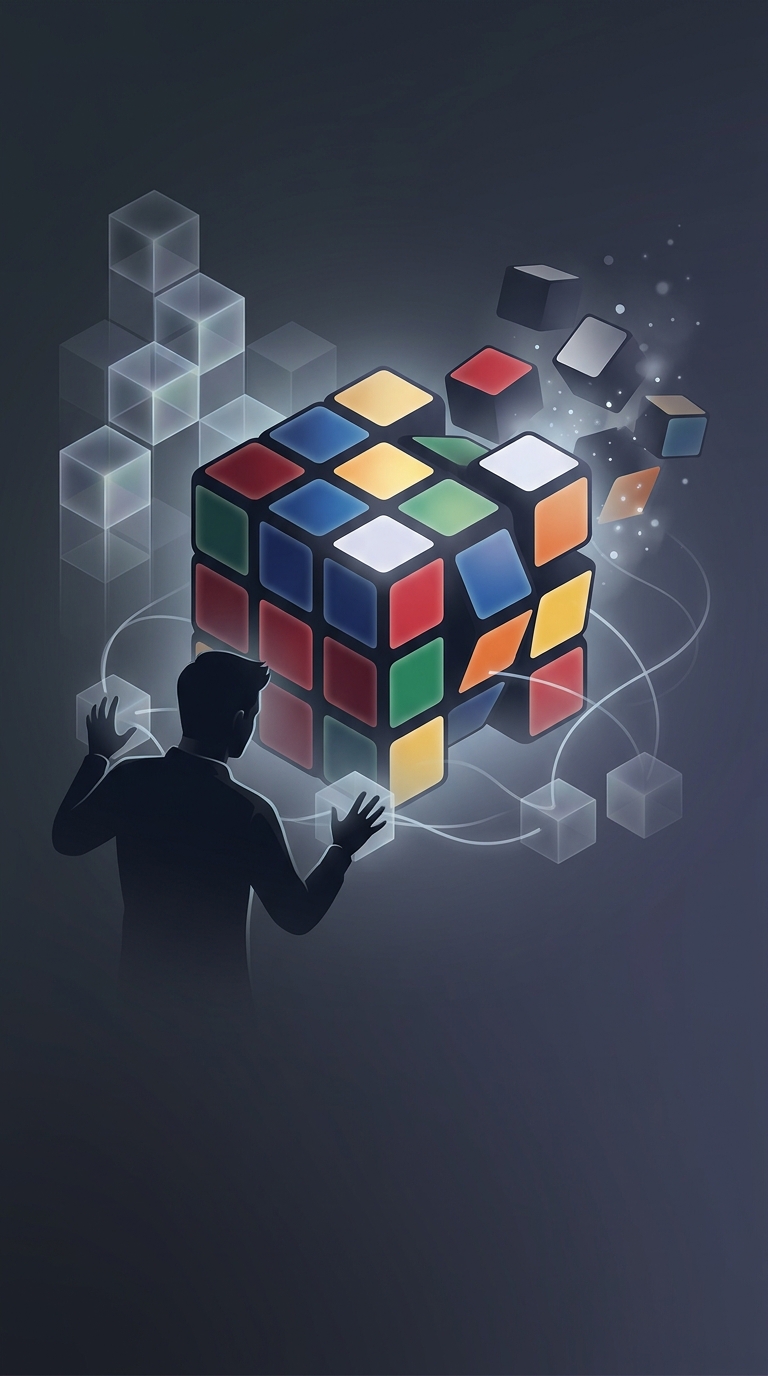
The cube’s pieces move as a system
On a standard 3×3 twisty cube, the colored squares are attached to three kinds of pieces: fixed-center pieces, two-color edge pieces, and three-color corner pieces. Turning a face moves the edges and corners around those centers; it does not let each square travel independently. That shared mechanism is what makes the puzzle more than a matter of arranging six colored faces.
A solver must put the right pieces in the right places without breaking the arrangement already built. Each turn changes several pieces at once, so a sequence that fixes one corner may disturb an edge elsewhere. Solving methods work by using repeatable sequences of turns that move selected pieces while preserving most of the cube.
Why stickers can make a false “solution”
Peeling off stickers bypasses that movement system. Someone can place colors to make the outside look solved even when the underlying pieces could never reach that arrangement through ordinary turns. Some configurations are mechanically impossible: for example, a single edge cannot simply be flipped in place, and two pieces cannot always be swapped alone. The cube’s legal moves preserve relationships among its pieces, imposing rules that a sticker job ignores.
That is why a neat-looking surface is not always evidence of a solved puzzle. The real test is whether the cube reached its arrangement through turns—and whether every edge and corner is oriented and positioned consistently with the cube’s mechanism.