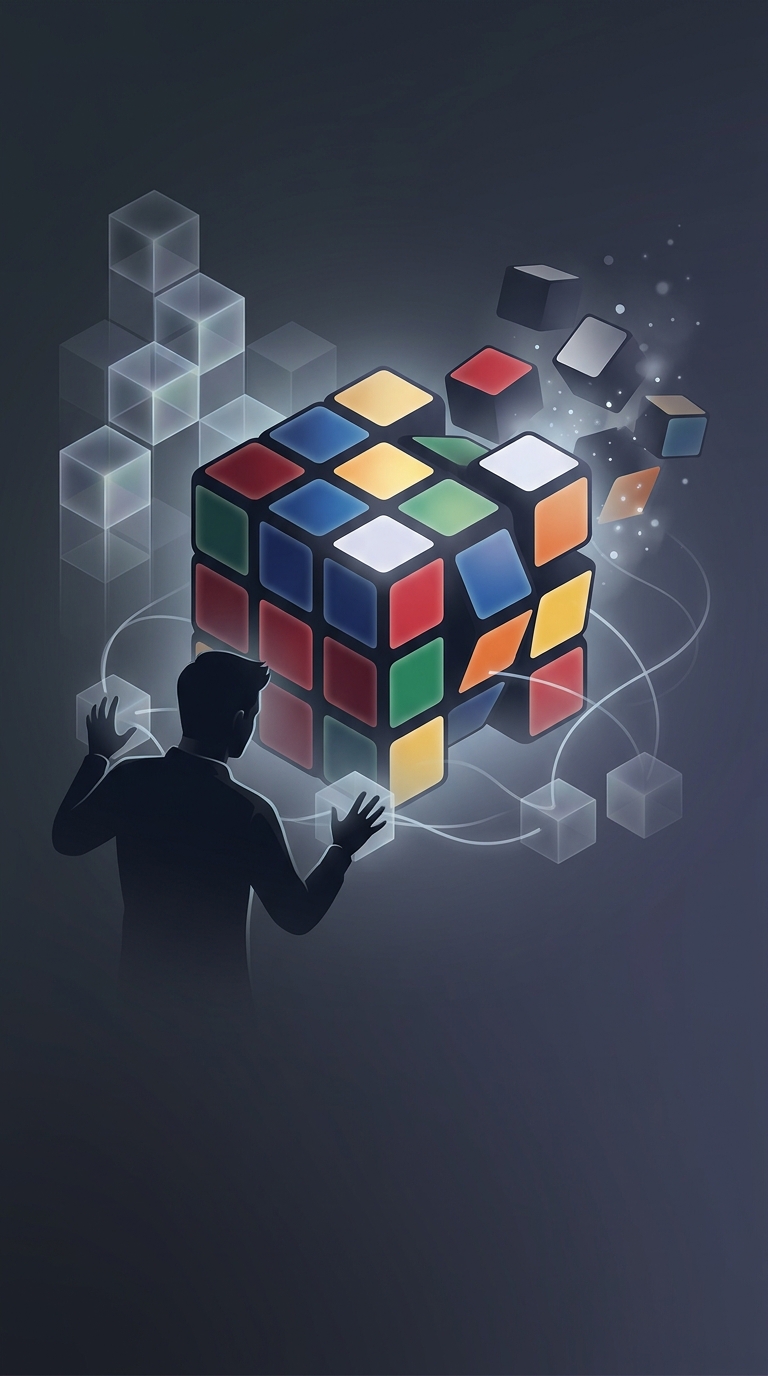
Why the cube’s enormous state space has a short route home
A cube’s pieces cannot be rearranged arbitrarily. The corners and edges move in linked ways, and each twist changes several pieces at once. That structure rules out many imaginable arrangements—and makes every legal scramble a position the cube’s own moves can undo.
The count of roughly 43 quintillion refers to distinct legal positions, not every possible way to scatter the colored stickers. It is also a count of arrangements, not a measure of how many turns a solver needs. Some positions are close to solved; others are much farther away.
What “20 moves” means
The move limit uses a standard counting rule: turning one face by a quarter-turn or a half-turn each counts as one move. Under that rule, 20 is the greatest possible distance from solved. This limit is often called God’s number: the minimum number that is sufficient for every legal position.
Establishing the limit required more than finding a clever solving trick. Researchers used computer searches to sort positions into manageable groups, exploiting symmetries and known routes to avoid checking every possibility in the same way. The result gives a mathematical guarantee, not a promise that a person—or a beginner’s method—will spot the shortest route.
That gap is part of the cube’s appeal: a position can look hopelessly tangled while still having a short optimal solution. The challenge is not that the way back is long, but that the right sequence is hard to see.