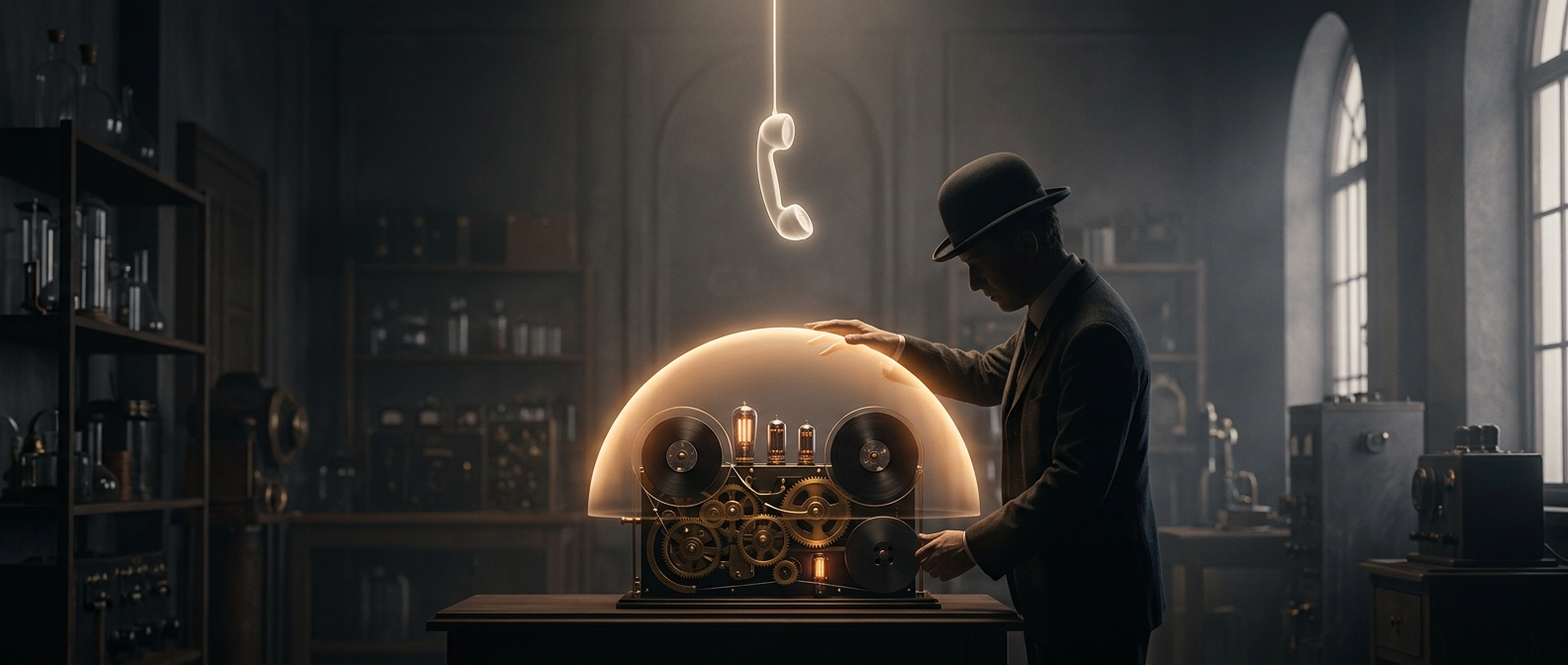
A Speaker Crossover Has a Job Before the Music Reaches the Tweeter
A loudspeaker often uses separate drivers for different parts of the audible range. The crossover is the circuit that sorts the incoming audio signal, directing higher frequencies to the tweeter and lower ones to other drivers. In Winslow Burhoe’s speaker designs, the tweeter used an inverted dome—a dome-shaped diaphragm that curves inward rather than outward—and its associated circuitry could look strikingly like an early electronic model of a neuron.
That resemblance is about circuit form, not a shared purpose. A crossover shapes audio signals for a speaker; a neuristor was an electronic device designed to imitate aspects of how a nerve impulse travels. Similar-looking arrangements of electronic components can arise when engineers solve very different problems.
The Interesting Link Is in the Pattern
Neuristors belong to a history of trying to represent a biological process with electronics. A speaker crossover, by contrast, is a practical piece of audio engineering: it must divide a changing musical signal so each driver handles the frequencies suited to it. The two circuits therefore invite comparison without being interchangeable or evidence that one was modeled on the other.
The connection is a reminder that circuit diagrams can echo one another across fields. A network built to route sound may call to mind a network built to mimic a nerve—not because they do the same thing, but because electronics offers a limited set of ways to arrange components and control signals.