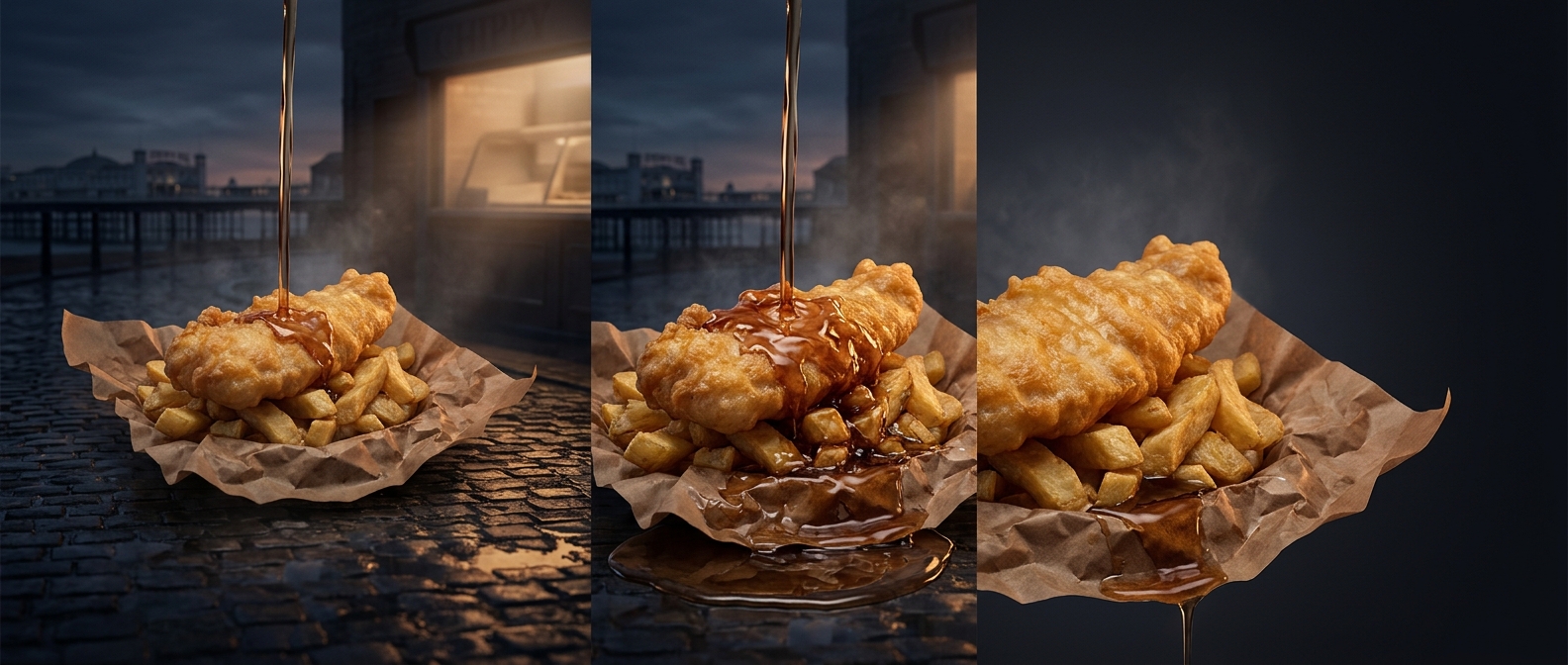
Why malt vinegar belongs on a British chip-shop plate
Malt vinegar brings more than sourness to fish and chips. It begins with malted barley, whose sugars are fermented into alcohol and then into acetic acid—the compound that gives vinegar its sharp bite. Compared with a clean, neutral vinegar, malt vinegar retains a rounded, grainy aroma that suits the browned flavor of fried batter.
A contrast that changes with every bite
Frying leaves food rich with oil, while vinegar’s acidity makes the palate register that richness differently. Its pungent aroma also cuts through the food’s heavier, toasted smells. That contrast helps explain why a generous splash can feel refreshing rather than simply sour.
But the vinegar has a physical effect, too. Once it lands on hot batter, its liquid seeps into the crisp outer layer and softens it. The plate therefore shifts as it is eaten: freshly dressed chips may have a sharp, crisp surface, while those left beneath the fish or at the bottom of the portion become softer and more saturated. The same dressing that balances the fried food also changes its texture.
A matter of personal timing
At a chip shop, salt and vinegar are often added at serving, so diners can choose how much—and how soon—the coating begins to soften. Some prefer a light splash; others want the vinegar to reach nearly every chip. The familiar “drenched” version is not a rule for every Briton, but it captures the appeal of the pairing: brightness on a rich meal, with crispness traded away a little at a time.