Getting an 8-Meter Mirror to Mauna Kea’s Summit
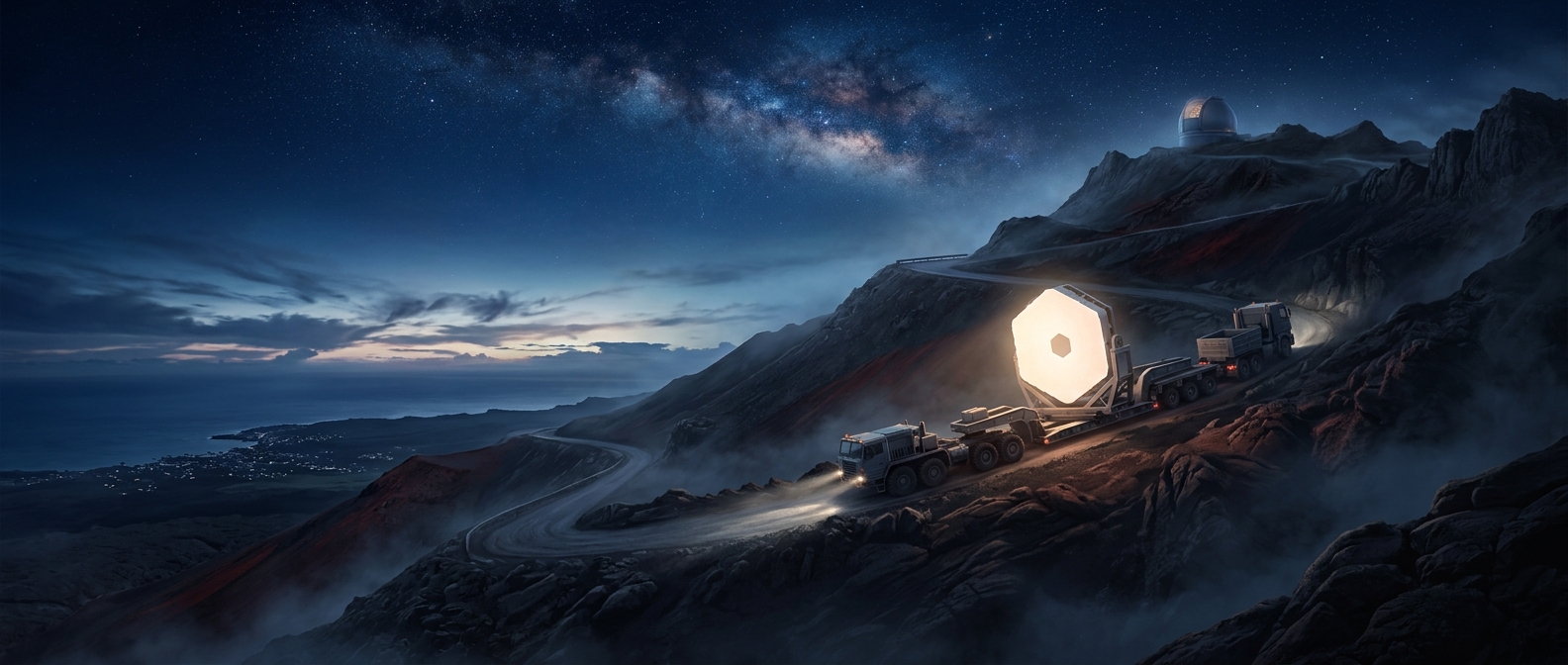
A telescope mirror is not just heavy cargo. Its carefully shaped surface must preserve the precise curve that gathers and focuses starlight; a chip or distortion could compromise the instrument. Gemini North’s primary mirror is about 8 meters across, large enough that moving it safely required a journey planned around both its size and its sensitivity.
The route climbed to the summit of Mauna Kea, a dormant volcano on Hawaiʻi Island. At more than 4,000 meters above sea level, the observatory sits far above the island’s towns and lowland roads. The final ascent meant carrying an enormous, delicate load up steep mountain roads, where abrupt jolts or a difficult turn mattered more than speed.
Why the Trip Had to Be So Careful
The mirror could not simply be treated like ordinary construction material and rushed uphill. Its transport had to protect the optical surface while negotiating the mountain’s grades and bends. That makes the journey a piece of telescope engineering in its own right: the observatory’s capabilities depended on delivering its most important component intact, not just building a large structure at the top.
Once installed, the mirror collects faint light from distant objects and directs it into the telescope’s instruments. Its enormous size helps Gemini gather more light, but it also makes moving the mirror a formidable logistical task. The telescope’s view of the universe began with a slow, careful trip up a Hawaiian volcano.