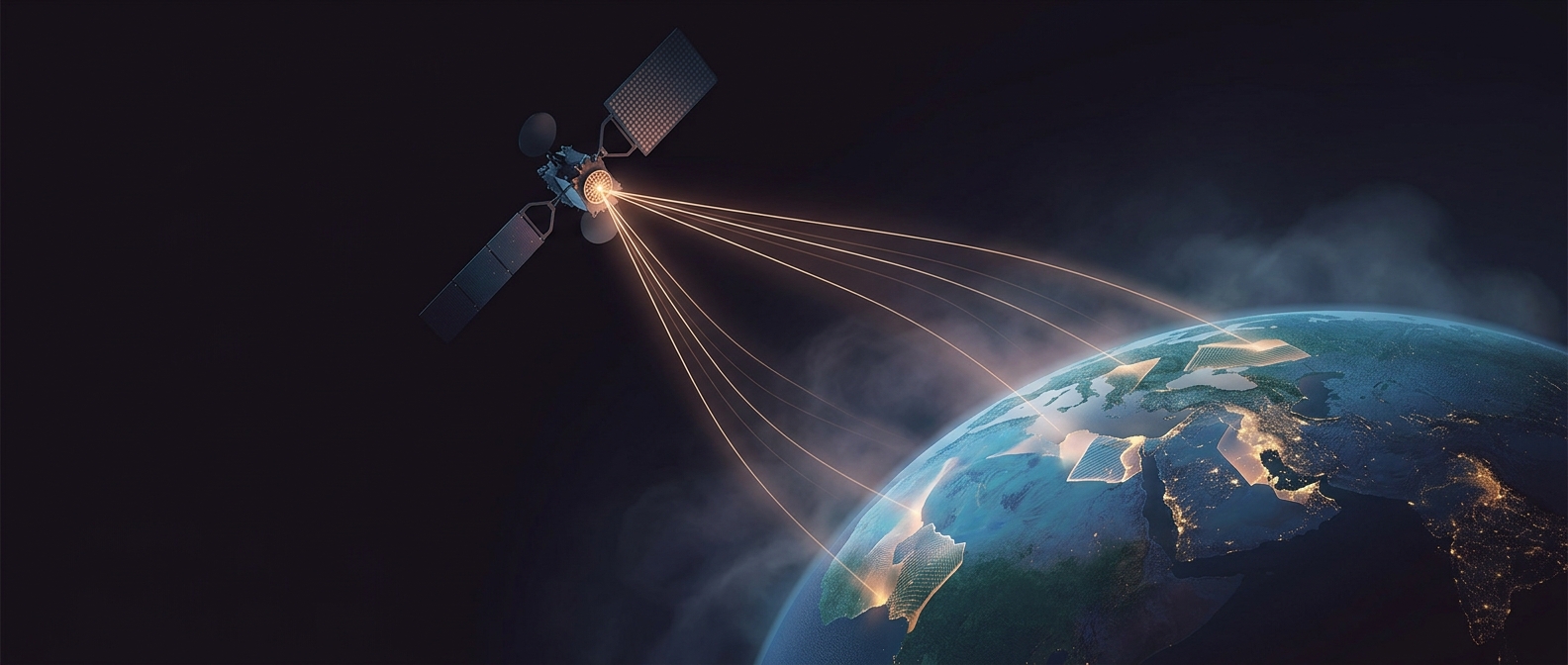
How a flat panel can follow a satellite
A satellite link depends on aiming a radio beam in the right direction. That is straightforward when the satellite appears nearly fixed in the sky, but a low-orbit satellite sweeps across it quickly. A terminal serving such a satellite must keep redirecting its beam—and may need to hand the connection to another satellite as the first moves out of range.
A conventional antenna can turn physically to keep pointing. Kymeta’s panel takes a different route: it changes how the panel itself handles radio waves, so the beam moves while the hardware stays still.
Steering with changing material properties
The panel is a metasurface: a thin structure patterned with many tiny elements that affect passing electromagnetic waves. In Kymeta’s design, liquid crystal—a material whose electrical properties can be altered by applying voltage—helps control those elements.
Changing an element’s response changes the timing, or phase, of the wave it sends back out. When neighboring elements impose slightly different phase shifts, their waves combine into a new wavefront traveling in a chosen direction. Adjusting those shifts electronically sweeps the beam across the sky. Software can make successive adjustments as the satellite’s apparent position changes.
This is not a beam that bends like a visible ray through glass. It is the combined effect of many radio waves interacting, controlled by the panel’s electrical pattern.
Why removing motors matters
A stationary panel avoids the motors, bearings, and exposed moving assembly used to point many traditional antennas. That can make a low-profile terminal easier to install on a yacht or vehicle, where space, vibration, and drag matter. Electronic steering also allows rapid redirection without waiting for a dish to rotate.
The practical benefit is not simply a flatter antenna: it is the ability to track a moving link without making the antenna itself chase it. On a vessel underway, the panel can remain fixed to the deck while its radio beam does the aiming.