Blake turned Swedenborg’s spiritual map inside out
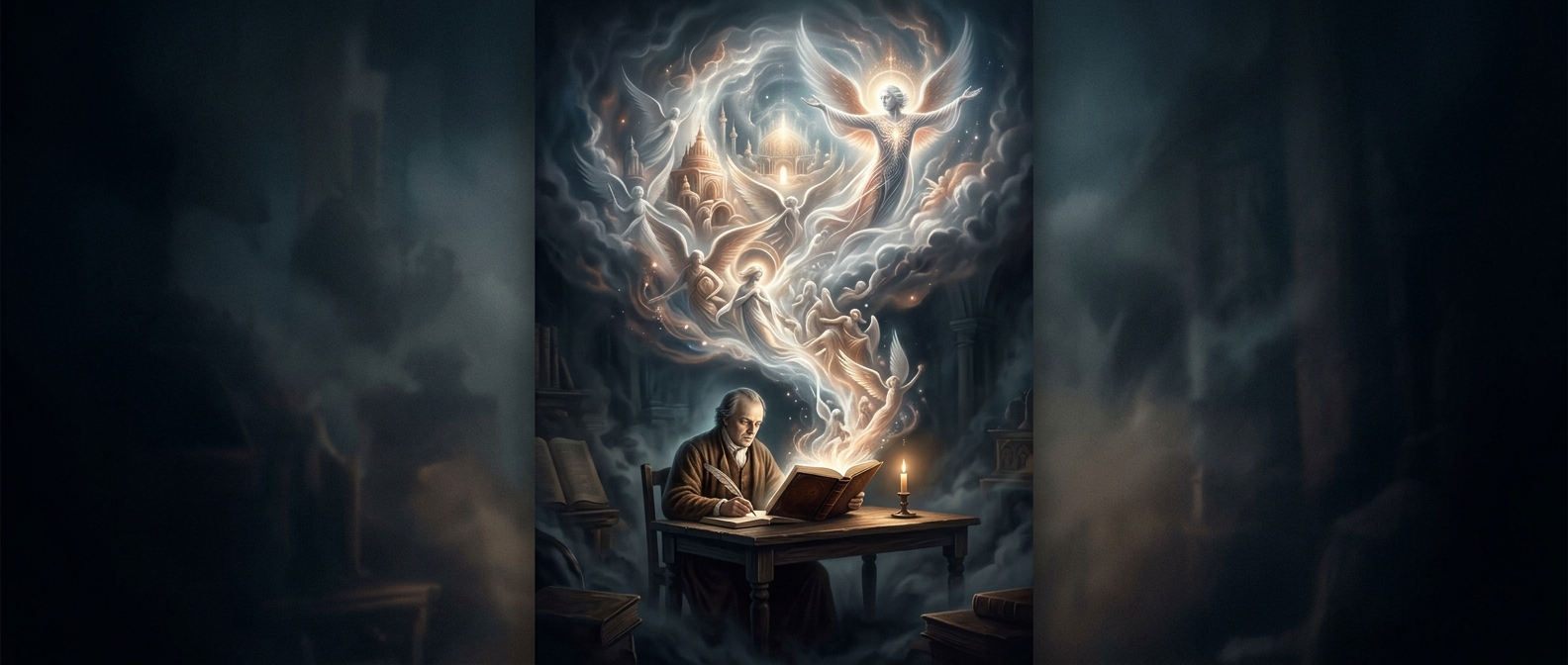
Emanuel Swedenborg described heaven and hell as spiritual worlds shaped by people’s inner loves and choices. They were not merely destinations assigned after death: in his account, a person’s character drew them toward one realm or the other. He also treated the physical world as full of correspondences—visible things that express invisible spiritual realities.
That way of reading the world gave William Blake a vocabulary for joining spiritual vision to vivid images. But Blake did not simply illustrate Swedenborg’s teachings or accept them as a finished system.
From influence to argument
In The Marriage of Heaven and Hell, written in the 1790s, Blake recast Swedenborg’s moral universe as a conflict between opposing forces. Where conventional religious teaching often treated passion as something reason must restrain, Blake made energy and desire sources of creative life. His “Hell” speaks with a force that unsettles the usual assumption that heaven alone holds wisdom.
The book’s title signals the twist: Blake imagines the apparent opposites as entangled, not neatly separated into good and evil camps. Its pointed, sometimes comic treatment of Swedenborg suggests that Blake saw the theologian as a starting point—and a target. He borrowed the idea that spiritual truth could be revealed through visionary images, then used that method to challenge what he regarded as rigid moral categories.
Why the connection matters
Blake’s response shows how an influence can work without becoming agreement. Swedenborg helped make an unseen spiritual world imaginable as something with structure and meaning; Blake used that imaginative framework to argue that human vitality could not be divided so simply into respectable virtue and sinful excess. The result is a work that borrows the language of religious revelation while turning it into a challenge to the boundaries that language was meant to enforce.