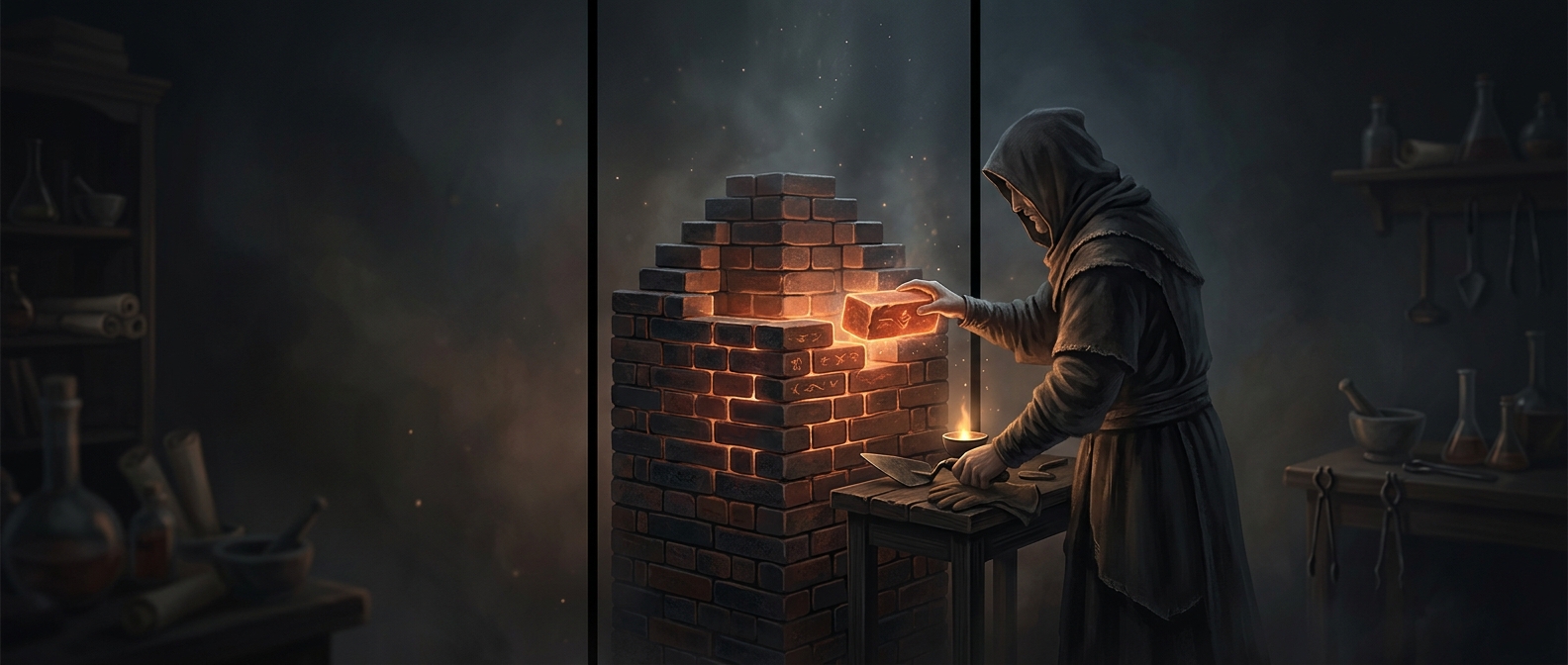
Why the Furnace Became a Spiritual Image
For an alchemist, a furnace was not merely a source of heat. It was a place where a material’s familiar form could be broken down and made to change. In calcination, for example, intense heating can turn some substances into ash or a brittle residue. The visible destruction suggested that what looked like an ending might also be a stage in transformation.
That made laboratory work a powerful metaphor for inner change. A person facing grief, discipline, or hardship might be imagined as undergoing a comparable ordeal: old habits and attachments were tested, leaving room for a more refined self. The analogy did not mean that every alchemist understood the soul in exactly the same way, or that suffering automatically made someone better. It offered a symbolic pattern—breakdown, testing, renewal—for interpreting difficult change.
Matter and Meaning in the Workshop
Alchemical writing often moved between practical operations and spiritual language. A recipe could describe heating, dissolving, or separating materials, while the same vocabulary also carried moral or religious associations. Because many texts were deliberately layered, the furnace could be both an instrument in the workshop and an image of a person being transformed.
The metaphor’s force came from the contrast between appearance and outcome. Fire seemed to destroy what went into it, yet the residue could be altered in ways that mattered to the alchemist’s work. In spiritual terms, an ordeal might likewise strip away what was considered false or unessential. The furnace therefore made an abstract claim tangible: transformation could be painful and disruptive, while still being understood as part of a larger process.