The joke depends on two versions of Stewie
Stewie Griffin is written with the ambitions and vocabulary of a scheming adult, but the world still treats him as an infant. That mismatch lets the show place elaborate plans in an ordinary family setting: Stewie can think in terms of control, revenge, or grand experiments while still being carried, dressed, and supervised like a baby.
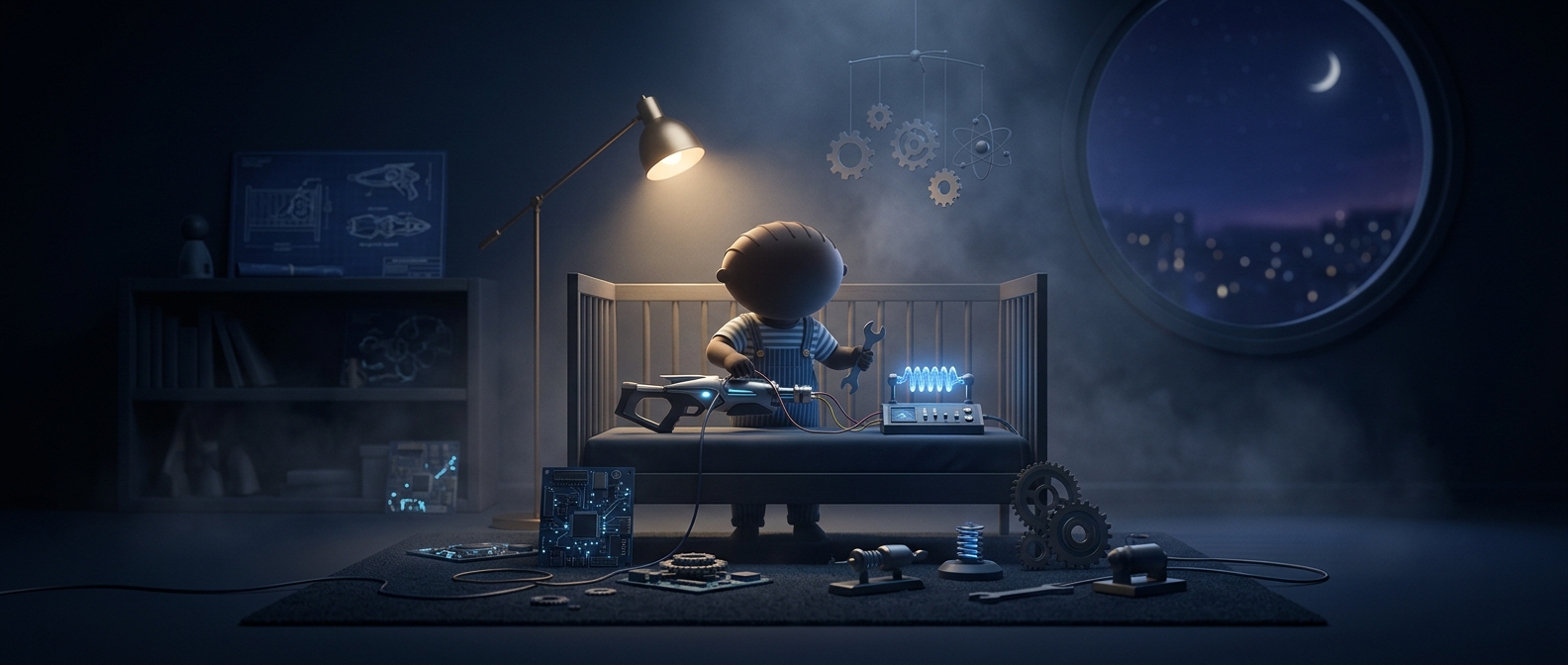
The inventions make the mismatch visible. A dangerous device is not just a strange object in the nursery; it is evidence of how seriously Stewie takes his own schemes, set against how little authority his age gives him in everyday life. The diaper is a reminder that, whatever he can build, he remains dependent on the people around him.
Dramatic irony keeps the family in the dark
Much of the humor comes from the audience seeing a threat that Stewie’s family does not recognize. The viewer can follow his plans, while relatives respond to him as a baby or overlook what he is doing. That gap creates dramatic irony: the audience knows more than the characters, so an ordinary family interaction can carry a second, more absurd meaning.
It also gives the writers a flexible comic engine. Stewie’s schemes can become fantastical, but the scene can still return to familiar domestic life—feeding, bedtime, or a parent trying to manage a child. The bigger the ambition, the funnier the contrast with those small routines. His arsenal matters less as realistic engineering than as a measure of the distance between the person Stewie imagines himself to be and the baby everyone else sees.