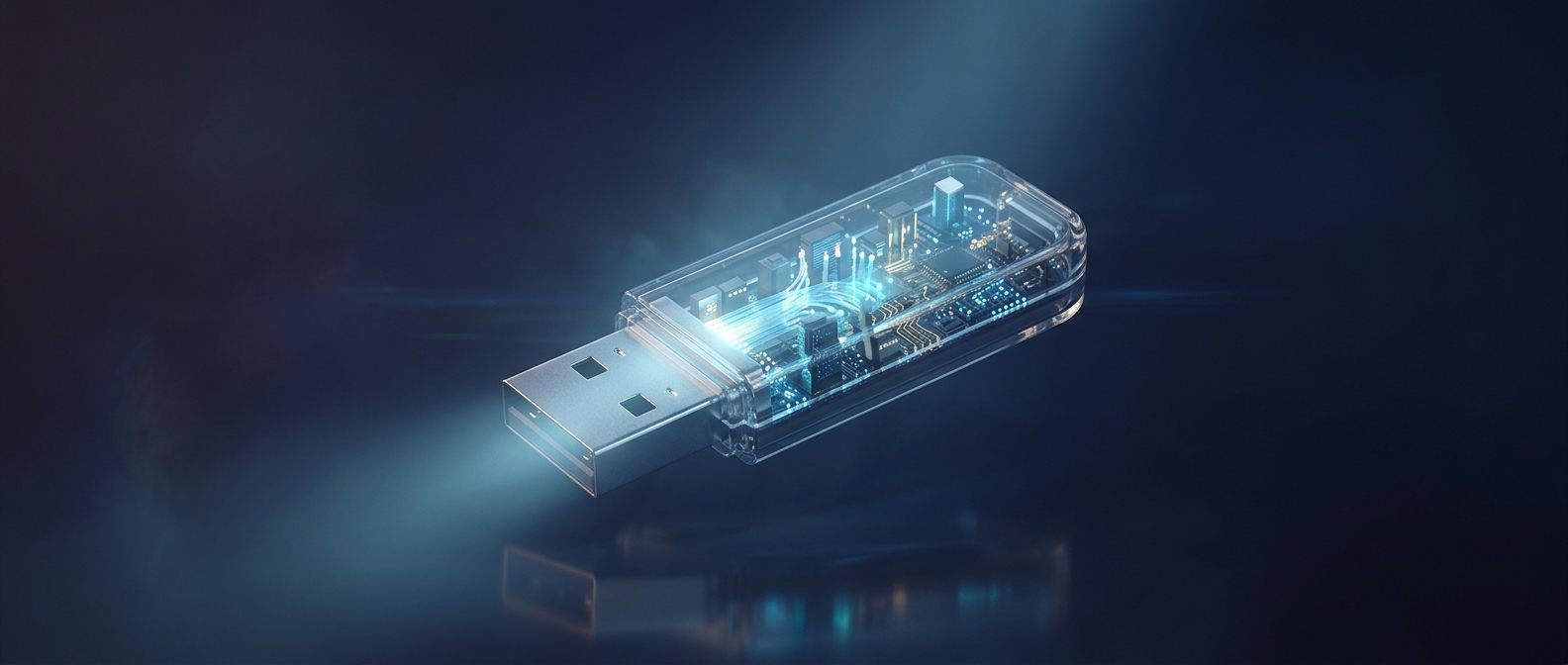
A small device aimed at a familiar routine
Replacing a floppy disk was not just a matter of fitting more files onto something smaller. Floppies depended on a dedicated disk drive: users inserted a flexible magnetic disk, saved files, then carried it to another computer with a compatible drive. A USB flash drive changed that handoff. It plugged directly into a USB port, turning the computer’s existing connector into a way to carry files.
Why flash memory changed the tradeoff
Inside a thumb drive, flash memory stores data electronically rather than on a spinning magnetic disk. With no moving parts, the device could take the knocks of everyday carrying more readily than a floppy, and it did not rely on magnetic storage. Its compact shape also made it easy to leave attached to a key ring or keep in a pocket.
The USB connection mattered as much as the memory itself. As USB ports became common on computers, people could move files without carrying a separate reader or opening a machine. The drive became a portable bridge between computers, useful for documents and other files that were awkward to share by email or network.
The replacement was about convenience, too
A modest capacity advantage could make a thumb drive attractive, but the stronger challenge to floppy disks was the whole package: a direct connection, sturdier storage, and less dependence on a specialized drive. Once USB flash drives became a routine feature of computer use, the floppy’s separate mechanism became an increasingly hard part of the old workflow to justify. The thumb drive did not merely hold files; it made carrying them feel simpler.