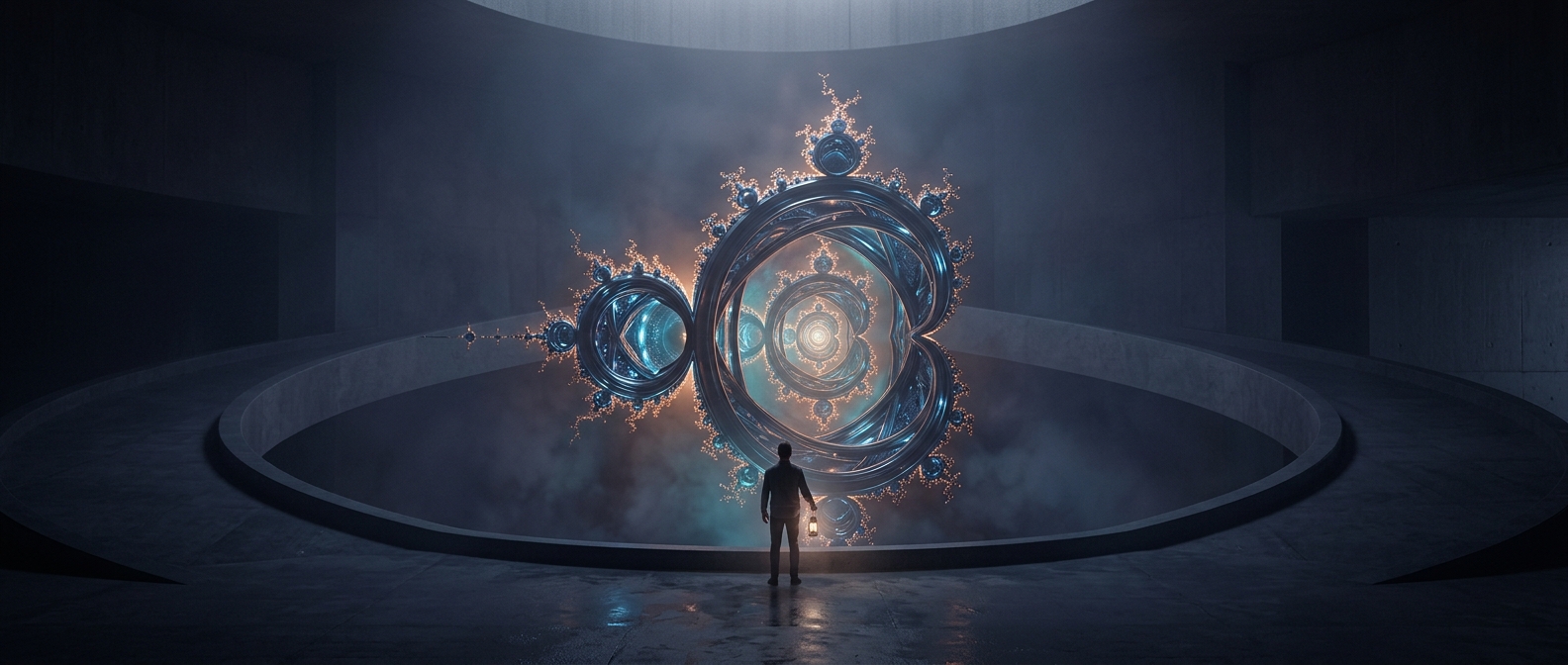
How a repeated rule makes a fractal
A fractal is a shape built by repeating a rule at progressively smaller scales. Start with a simple shape, apply the rule to it, then apply the same rule to the new details. In the Sierpiński triangle, for example, removing the middle triangle leaves three smaller triangles arranged like the original; repeating that removal creates the pattern’s nested structure.
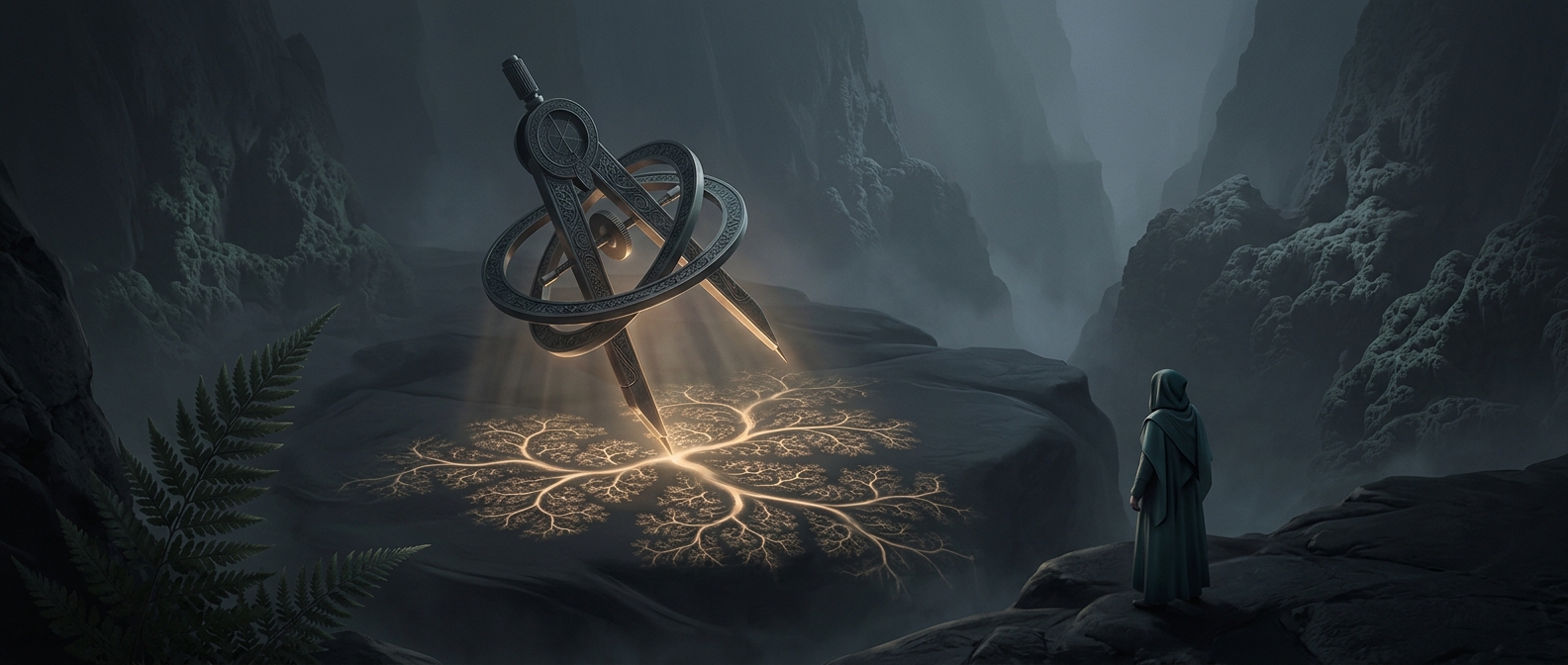
The resemblance can be exact, as in ideal mathematical constructions, or approximate, as in many natural forms. A fern’s small fronds may echo the shape of the whole leaf, but they are not perfect copies. Fractals are less about any one familiar motif than about structure recurring across scales.
What “infinitely inward” means
In mathematics, the construction can continue without a final step. Zoom in on an ideal fractal and the defining pattern appears again at smaller scales, potentially forever. This is different from an ordinary photograph: a digital image has limited resolution, so eventually magnification reveals pixels rather than finer detail. Physical objects also have limits; a coastline or a fern does not reproduce its pattern down to infinitely tiny scales.
That distinction makes fractals useful for describing complexity without claiming that nature is literally infinite. A coastline, for instance, can look increasingly jagged as it is measured more closely, because small bays and inlets become visible. The scale of measurement changes the detail you count—and the mathematical fractal provides an ideal model for how such detail can recur.