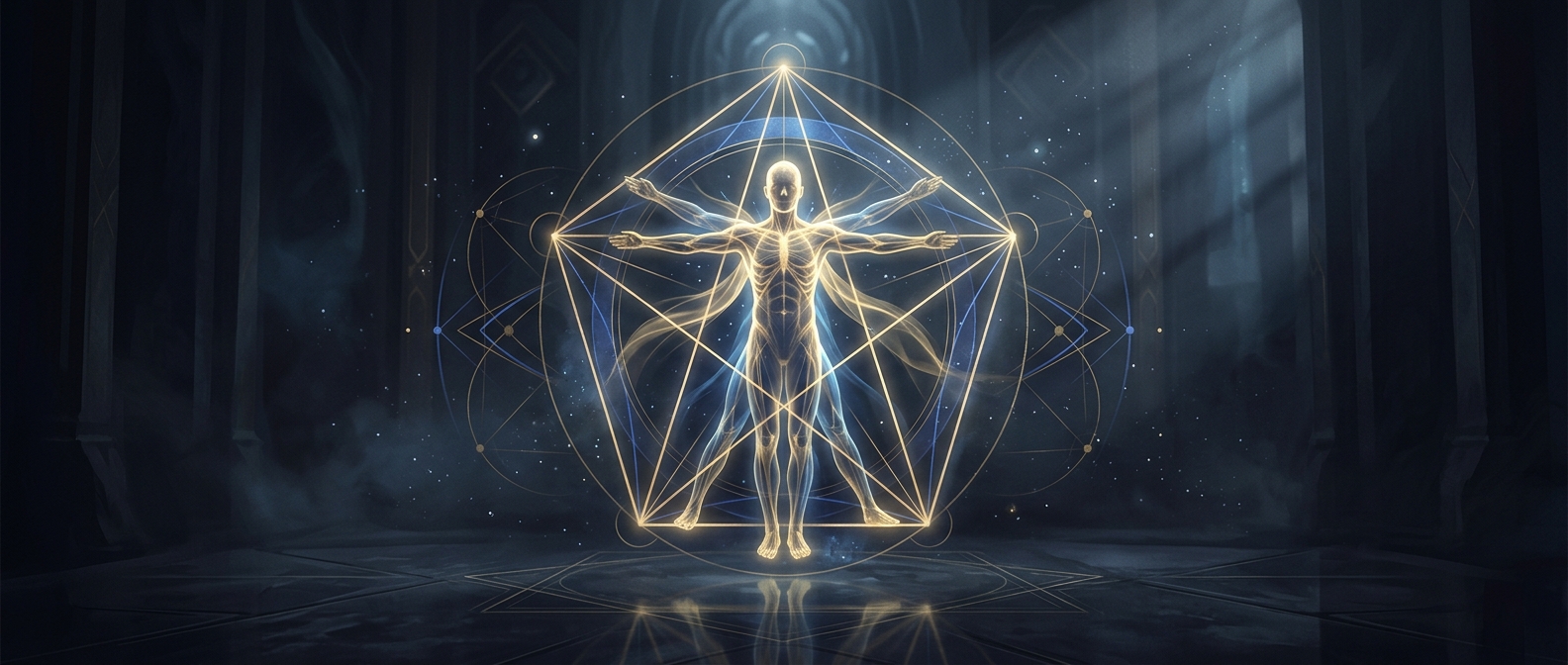
Why Five Shapes Became a Symbolic Set
The five Platonic solids are the tetrahedron, cube, octahedron, dodecahedron, and icosahedron. Each is a regular three-dimensional form: its faces are identical regular polygons, and the angles and arrangement are consistent throughout. They are also the only convex solids with that kind of complete symmetry. Their rarity helps explain why they became a natural focus for systems that look for order and meaning in geometric form.
From Geometry to Elemental Meaning
The association with foundational elements comes from an ancient philosophical tradition, especially Plato’s account in Timaeus. In that scheme, the tetrahedron was linked to fire, the cube to earth, the octahedron to air, and the icosahedron to water. The dodecahedron was assigned a broader cosmic role rather than matching one of those four familiar elements.
These pairings were symbolic interpretations, not measurements of physical matter. The shapes offered a visual language for qualities people associated with the elements: the cube’s stable, level faces could suggest earth, while the tetrahedron’s sharp points could suggest fire. Later sacred-geometry traditions inherited and adapted such correspondences, sometimes giving the forms additional spiritual meanings.
What the Geometry Contributes
The symbolism rests on a real mathematical distinction: each solid is built from a repeated face, and the same pattern meets at every vertex. But geometry alone does not dictate what a shape represents. The element attached to a solid comes from a cultural framework layered onto its structure.
That combination is why the five forms remain recognizable in sacred geometry: they are exceptionally ordered shapes, while their elemental meanings turn that order into a map of the world as people once imagined it.