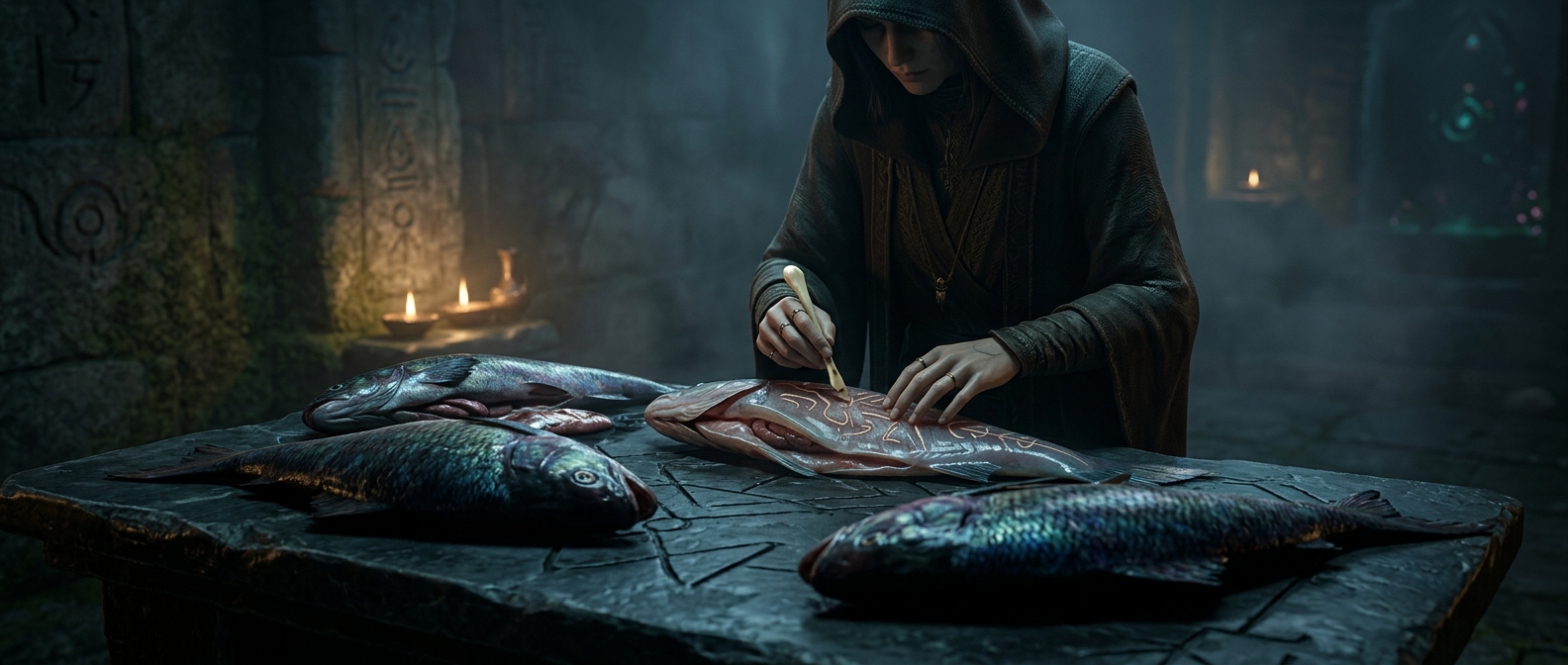
Reading the Fish as an Omen
Divination by fish—sometimes called ichthyomancy—turns a fish’s body or behavior into a sign. In one form, a practitioner examines organs after a fish has been killed; in another, the observer watches living fish move and treats their direction or activity as meaningful. The fish is not delivering a message in words. The interpreter supplies meaning by connecting what they see to a question, a tradition, or an expected pattern.
That makes the reading more than a close look at animal behavior. It is a system for turning an uncertain event into something that can be discussed: a particular movement or physical feature becomes a clue, and the clue is weighed against the decision at hand. The interpretation depends on the rules and expectations of the people performing the ritual, rather than on a universal fish “language.”
Why Put a Decision in the Fish’s Hands?
When a choice feels risky or hard to settle, an omen can provide a structured way to pause and seek direction. The ritual may also make a decision feel shared or authorized: the outcome is framed as something observed, not merely chosen by one person. That can matter even when different observers might read the same sign differently.
The practice belongs to the history of divination—the use of signs to seek guidance about uncertain matters—not to a dependable method for forecasting what will happen. Its revealing feature is the role assigned to the animal: ordinary movement or anatomy becomes significant because people have learned a framework for reading it. A fish’s turn in a tank may be biologically ordinary; within the ritual, it can become the moment a question receives an answer.