The joint that lets a long tram turn
A tram made from one rigid body has to keep every part of its frame aligned as it follows the rails. That works for a short vehicle, but a longer one would need a broad turning path: its front and rear cannot both follow a tight curve without parts of the body swinging far outside the track.
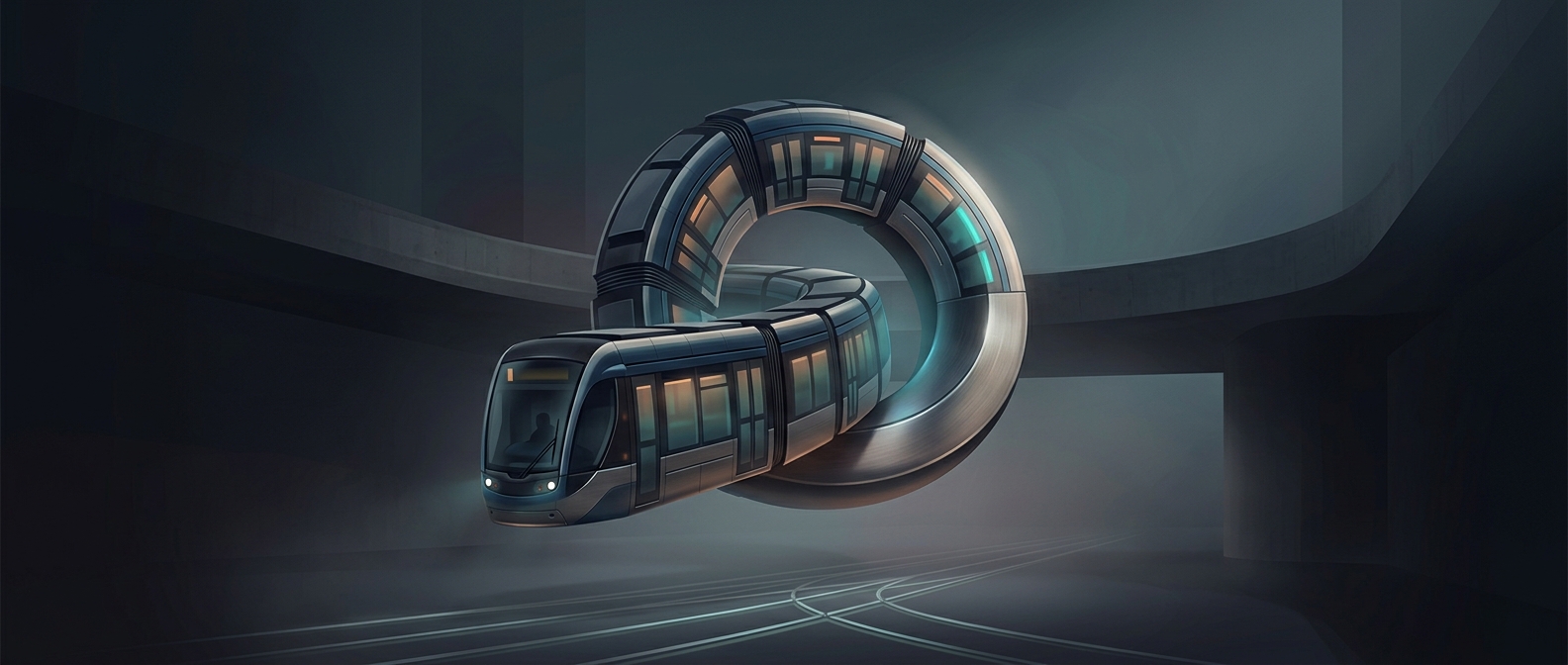
An articulated tram solves this by splitting the passenger space into sections connected by a pivoting joint. As the front section follows the curve, the joint changes angle and the section behind it follows a slightly different direction. The tram can therefore carry more people without behaving like one exceptionally long rigid box.
The connection is doing more than bending
The joint must let the sections rotate relative to each other while still carrying the loads between them. It also has to accommodate the floor and the passenger passage across the gap. A flexible bellows—an accordion-like cover—usually closes that gap, keeping the interior usable as the sections turn.
The bend is a response to the track, not a trick in which the whole tram folds at its midpoint. Each section remains a solid vehicle body; the angle is concentrated at the connection. On a curve, that angle makes the long tram behave more like linked shorter vehicles, helping it negotiate streets where a single rigid body of the same total length would be impractical.
The tradeoff is that the connection adds a moving, load-bearing part that must be designed and maintained. Its payoff is visible whenever the tram enters a bend: the sections change direction one after another, allowing a long passenger vehicle to follow rails laid through a compact city street.