How a knuckle coupler catches the next car
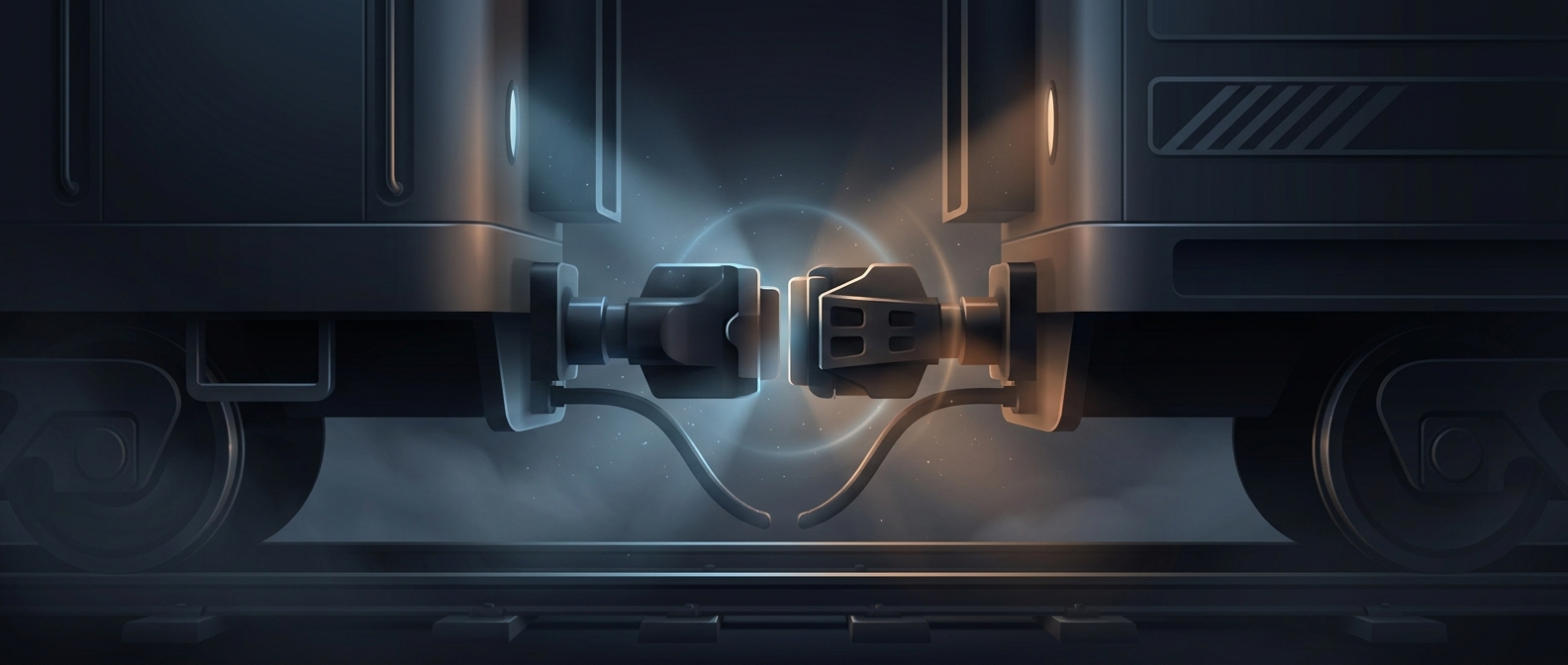
A freight car’s coupler is built to take a hard meeting and turn it into a secure connection. Its curved metal knuckle pivots on a pin. When the cars are brought together, the knuckles meet and swing aside; as they pass, each returns around the other. A locking piece inside the coupler drops into place, trapping the knuckles so they cannot swing open under the pull of the train.
The shape does much of the work: the cars need to be lined up closely enough for their couplers to meet, but the crew does not have to guide a pin into a hole by hand. The connection happens at the point of contact.
The impact is part of the design
Coupling is not a delicate touch. The cars roll together, and the couplers take the impact. Behind each coupler, a draft gear—a shock-absorbing mechanism—compresses to soften the jolt and reduce the force passed into the car body and its load. That give matters because freight cars are heavy, and even a modest impact can travel through a long string of connected cars.
Once coupled, the knuckles keep the cars joined while the train starts, stops, and changes speed. The coupler’s locking mechanism can later be released with an uncoupling lever, allowing cars to separate without someone reaching between them.
One connection, not every connection
The metal coupler joins the cars mechanically. Other links may still need attention: on many trains, air hoses for the braking system are connected separately, and some electrical connections also require their own coupling. So the handshake is automatic in the crucial sense that the cars’ steel connection locks through contact—but assembling a working train can involve more than that one snap.
The practical payoff is a safer, faster way to join cars: the crew can make the connection from beside the track rather than putting hands between two moving vehicles.