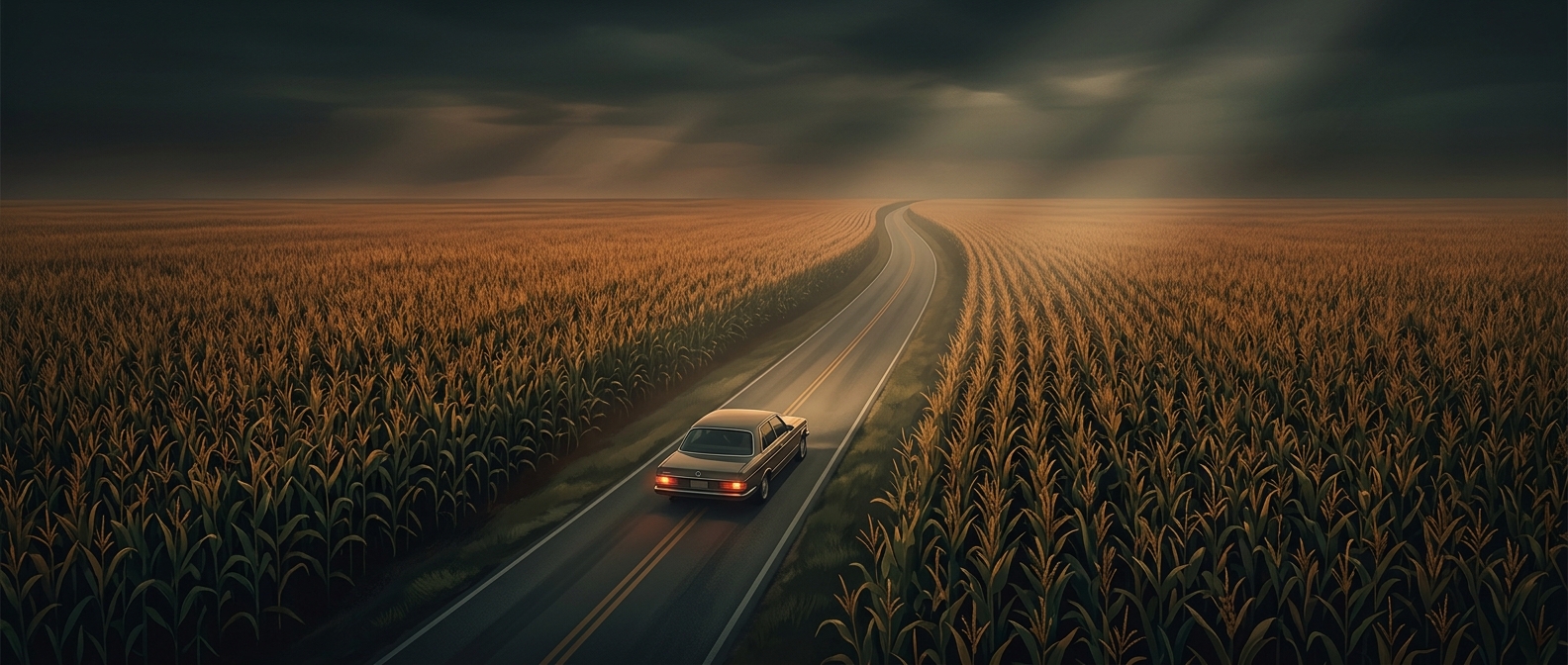
Why Nebraska’s Farmland Can Look Like It Goes on Forever
The repeating view is most characteristic of eastern and central Nebraska, where broad stretches of cropland meet long, straight roads. Much of the land is gently rolling rather than perfectly flat, but from a car the low rises can disappear into the horizon. With few buildings or trees to interrupt the view, one field seems to run straight into the next.
A Working Landscape, Not One Endless Cornfield
Corn is a major crop, but Nebraska farms also grow soybeans and other crops, and the balance varies by place and season. Farmers often rotate crops—growing different plants in the same field in successive years—which helps manage soil and pests. A roadside field that is green corn in summer may be harvested, bare, or planted with another crop at a different time of year.
The impression of sameness comes partly from scale: fields are large enough that their boundaries can be hard to see from a moving car. Straight roads and regularly spaced intersections add another repeating pattern, a legacy of land surveyed and divided into a grid. The combination makes distance feel unusually uniform.
The View Changes as You Cross the State
Nebraska is not a single, unbroken sheet of corn. Farther west, drier conditions favor more grazing land and different agricultural patterns; river valleys and towns also break up the view. So the “infinite” fields are a memorable stretch of the trip, not a guarantee for every mile. The striking effect comes from seeing a vast, carefully divided working landscape from a road that keeps pointing toward the same low horizon.