How One Beam Becomes Two
In an ordinary transparent material, light of a given color travels at essentially one speed in every direction. A birefringent crystal is different: its internal structure makes the optical response depend on the light’s polarization—the direction in which its electric field vibrates.
At the crystal’s surface, incoming light can be resolved into two allowed polarization patterns. Each pattern experiences a different refractive index, the measure of how much a material slows light. Because light’s speed inside a material is its vacuum speed divided by that index, the two patterns travel at different speeds.
Why the Rays Separate
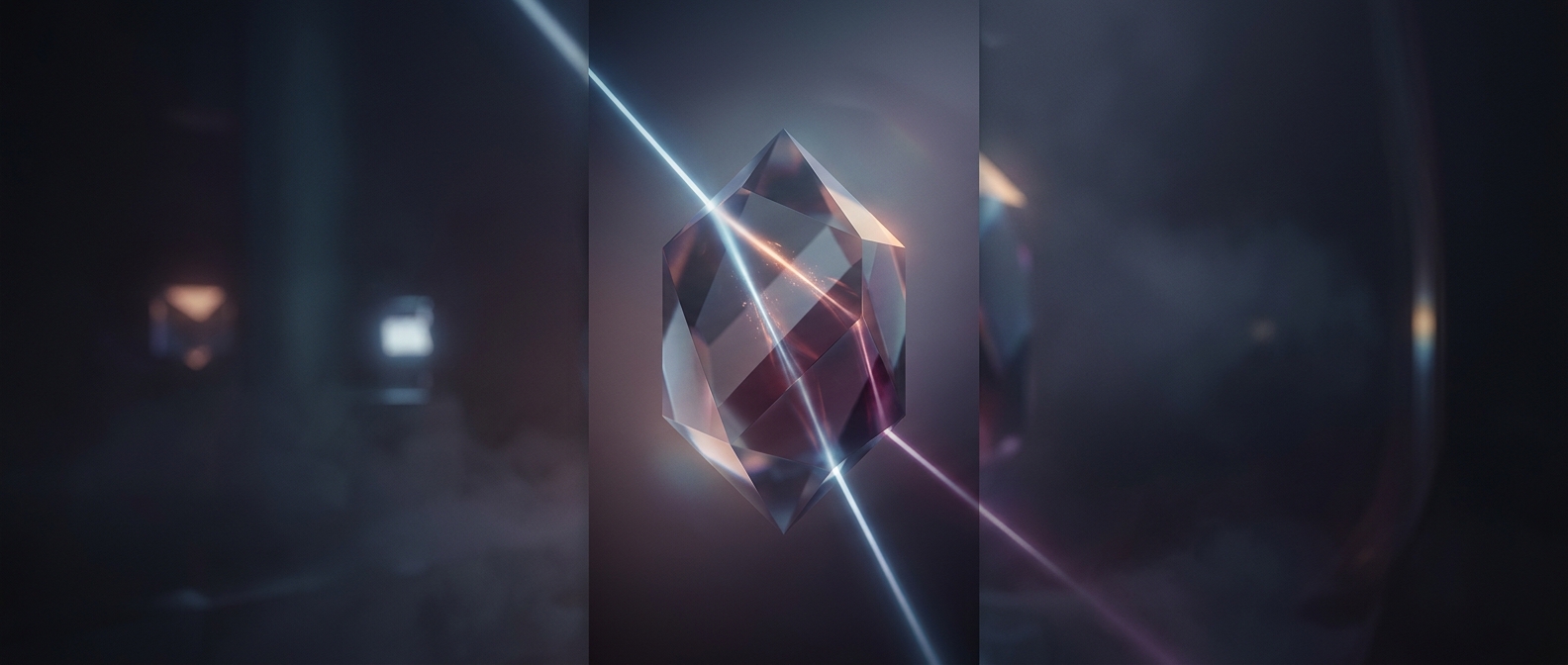
The speed difference is only part of the effect. In many birefringent crystals, the two polarization modes also travel in slightly different directions. They therefore emerge as two beams, often shifted apart, rather than simply continuing as one beam with two speeds mixed together. Their paths and speed difference depend on how the crystal is oriented relative to the incoming light.
This is why a suitable crystal can make a single image appear doubled: each image is carried by one of the two polarization modes. Rotate the crystal, and the separation or direction of the images can change. The crystal is not steering light with moving parts; its ordered internal structure gives different polarizations different optical routes.