The rotor sees two different winds
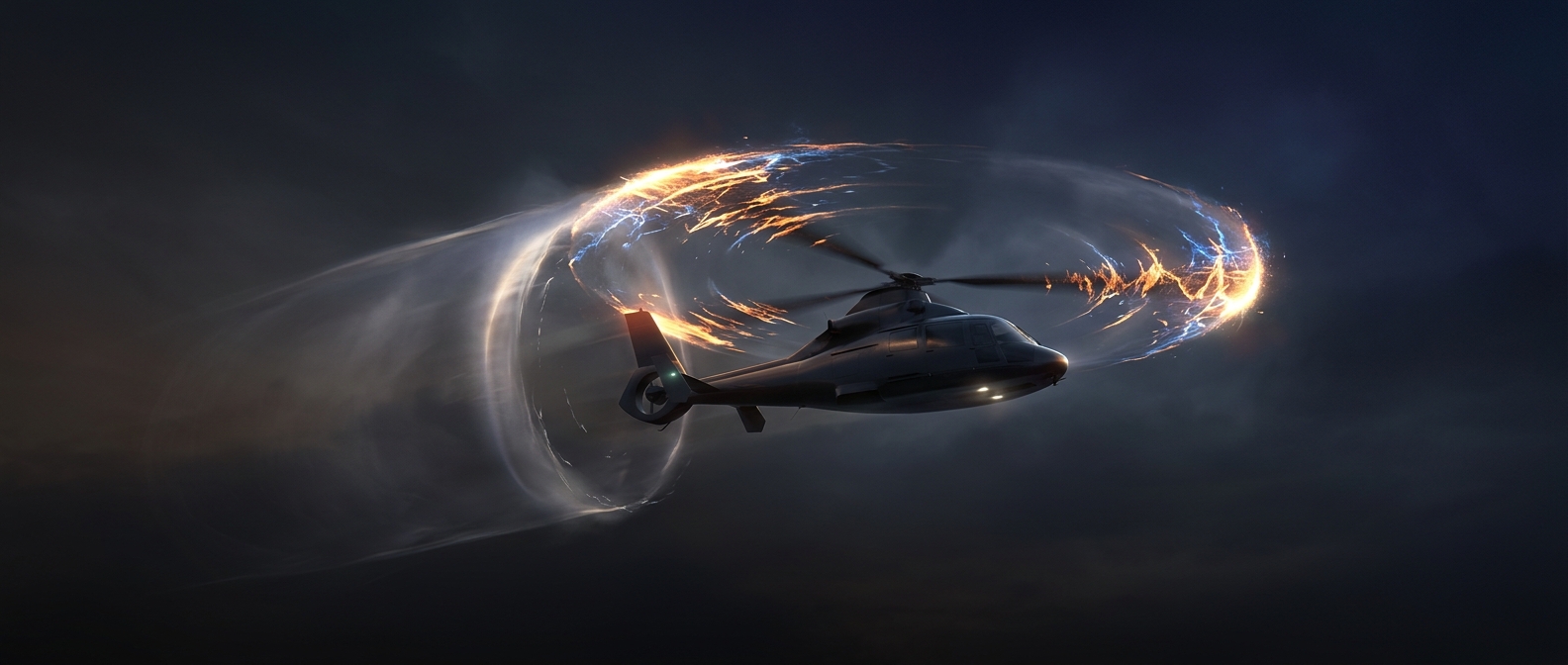
A helicopter’s blades do not move through the air at the same speed. As the rotor turns, the blade sweeping toward the helicopter’s nose meets the aircraft’s forward motion head-on. Its speed through the air is the rotor’s rotational speed plus the helicopter’s speed. The blade sweeping backward has the aircraft’s motion working against it, so its relative airflow is slower.
That difference matters because a rotor blade is a small wing: it needs airflow to generate lift. As the helicopter speeds up, the retreating blade gets less airflow. To keep supporting its side of the rotor, it must work at a steeper angle to the air—a change pilots and engineers call increasing its angle of attack.
Why adding power stops helping
At a certain point, the retreating blade’s angle becomes too steep and the airflow separates from its surface. This is a stall: the blade loses lift and produces more drag. The result can be shaking, reduced control, and a loss of lift on that side of the rotor. More engine power cannot restore smooth airflow; it can instead increase the stress on the rotor system.
Helicopter controls can redistribute lift across the rotor, and blade designs can delay the problem. But those adjustments have limits. Meanwhile, the blade moving forward faces its own constraint: at high aircraft speeds, parts of it can approach the speed of sound, creating sharply increased drag and potentially damaging shock effects.
A limit set by the whole rotor
The practical speed ceiling is therefore a balance between problems on opposite sides of the rotor: the retreating blade risks stalling while the advancing blade encounters increasingly severe airflow. The exact limit depends on the helicopter’s design and conditions, not on a single universal number. It is a reminder that a rotor cannot behave like a propeller simply driven faster—the air must keep working across every part of its turning disk.