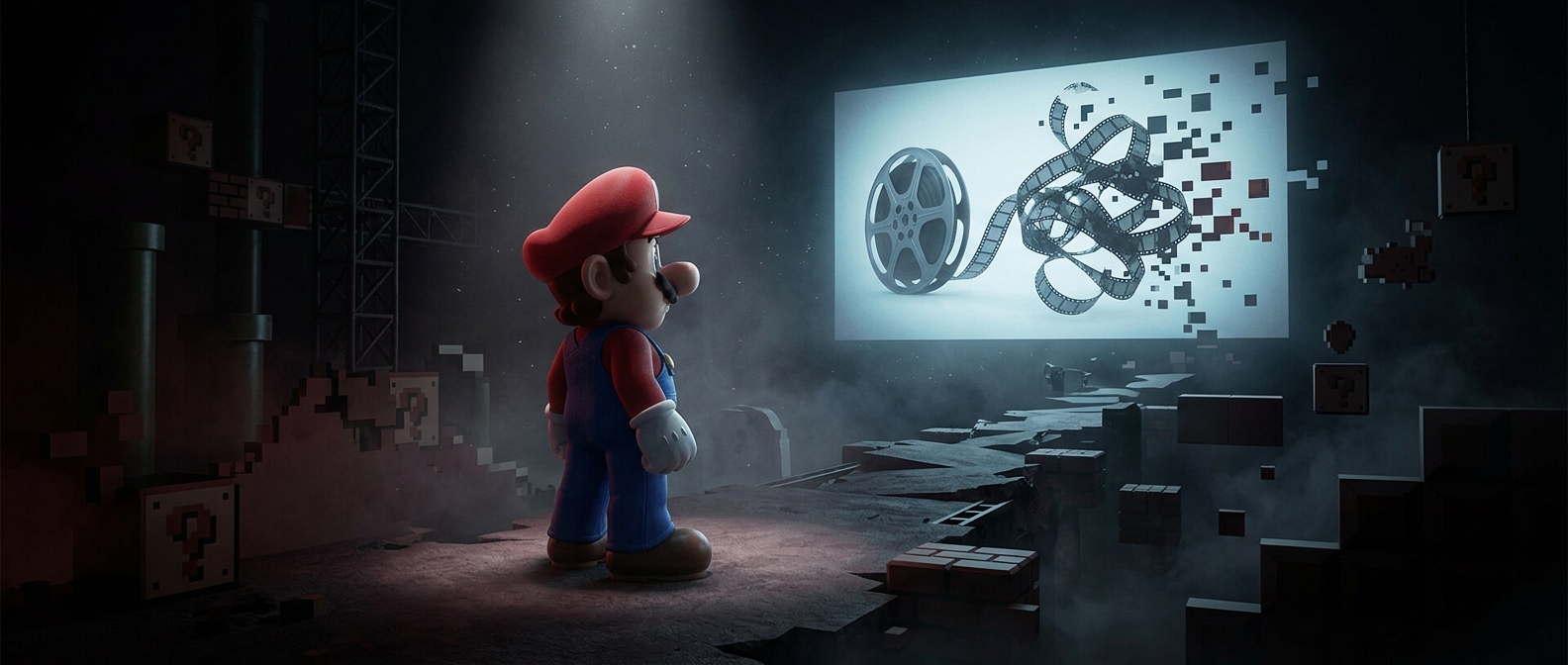
How Mario Became a Cyberpunk City
The 1993 Super Mario Bros. movie faced a basic problem: the game offered characters, hazards, and a goal, but little conventional plot. Its screenwriters had to invent a world that could sustain a feature film. They imagined the Mushroom Kingdom as a parallel dimension and reshaped its cheerful fantasy into a polluted, industrial city ruled by President Koopa, played by Dennis Hopper.
That choice made the film less a literal translation of the game than a speculative attempt to explain it. The familiar mushrooms, dinosaurs, and power-ups were recast as elements of a strange biological and political system. Mario and Luigi, played by Bob Hoskins and John Leguizamo, became working-class plumbers navigating a dense urban environment rather than simply moving through bright, self-contained levels.
The Cost of Making a Game into a Film
Games can build meaning through repeated action: players jump, explore, and learn rules firsthand. A movie has to communicate its world through scenes and dialogue, while carrying viewers through a fixed sequence. The filmmakers therefore added backstory, villains, and social conflict—but those additions pulled the movie toward a darker, more elaborate tone than the source material’s playful simplicity.
The production’s elaborate sets and effects also made the adaptation an ambitious undertaking. Yet spectacle could not by itself resolve the central mismatch: the game’s appeal came from direct control and clear, immediate challenges, while the film had to turn those experiences into a conventional story. The result was a striking reinvention, but not one that satisfied many fans or critics.
A Long Pause for Nintendo
The movie’s failure made live-action adaptation a costly risk for Nintendo. The company largely avoided licensing its game characters for live-action films for decades, protecting them from another interpretation that might stray far from the games’ identity. The episode is a reminder that adaptation is not just about reproducing recognizable details: it is also about deciding which parts of an interactive experience can survive when the audience can no longer play.