Why the Sagrada Família Takes So Long to Build
The Sagrada Família is not simply a large church assembled from a standard set of plans. Antoni Gaudí designed it as a dense, three-dimensional composition of towers, sculpted façades and branching interior columns. Many of its shapes imitate patterns found in nature, but translating those forms into stone and structural supports takes painstaking design and construction.
Work began in 1882. Gaudí later reshaped the project around his own architectural vision, and construction continued after his death in 1926. The long timeline reflects both the building’s complexity and the fact that it has been erected in stages, rather than completed from a single, unchanging blueprint.
A Design That Had to Be Rebuilt
The project also suffered a major interruption during the Spanish Civil War, when many of Gaudí’s workshop materials, including drawings and models, were destroyed. Later architects had to reconstruct parts of his intentions from what survived and from the building itself. That made progress more complicated than simply following a complete set of original plans.
Modern computer modeling and construction equipment have made it possible to develop and build intricate forms more efficiently than in Gaudí’s era. But technology cannot eliminate the time needed to engineer, fabricate and fit the many different components of a structure this unusual. New work also has to connect coherently with the parts already standing.
Visitors Help Keep the Work Moving
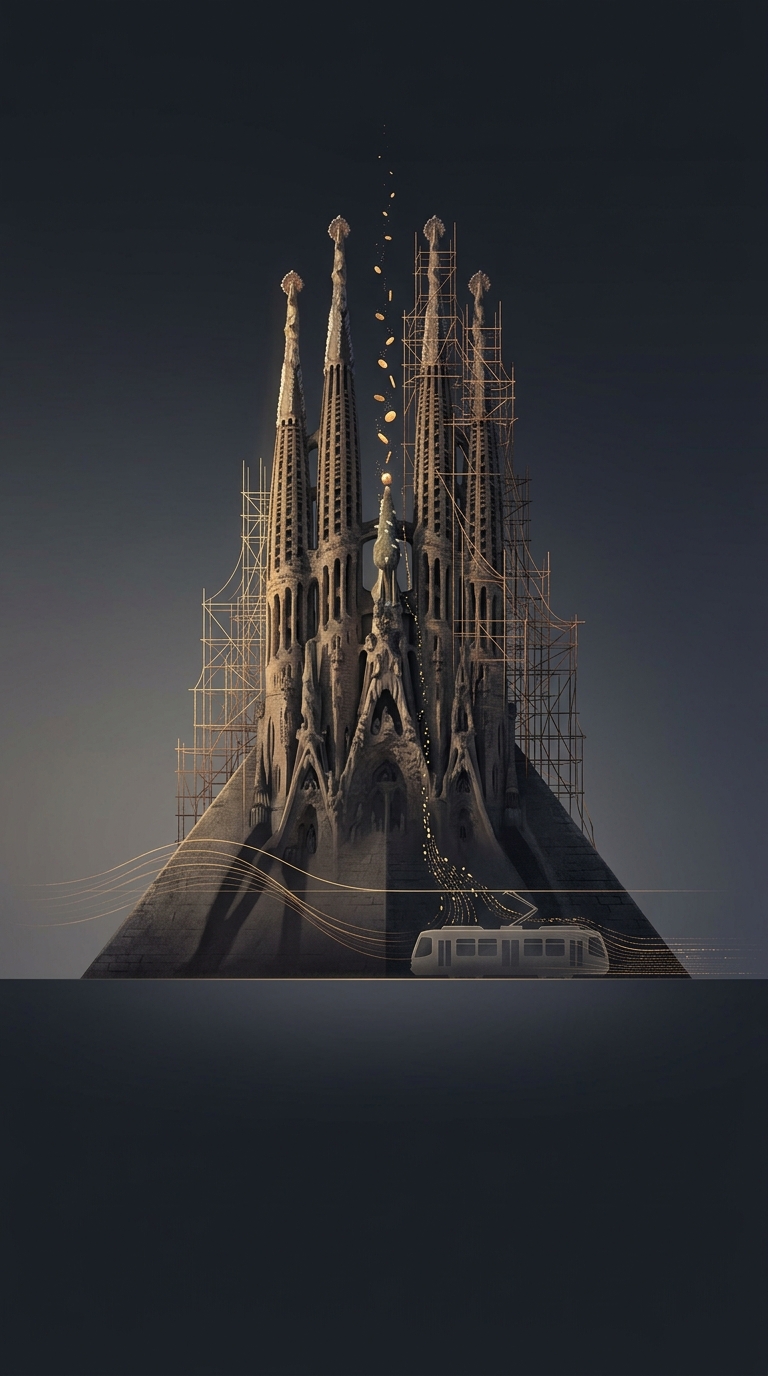
Unlike a public monument funded through a single government construction budget, the basilica’s work has relied heavily on donations and income from visitors. Ticket sales therefore help pay for continued building, linking the experience of seeing the church to the means of completing it.
That is why scaffolding is a recurring part of the view: it marks active work on a building whose decoration and towers are still being finished. The construction site is not an accidental interruption to the Sagrada Família’s story. It is the visible result of a design so elaborate—and a building program so extended—that visitors encounter the making of the monument alongside the monument itself.