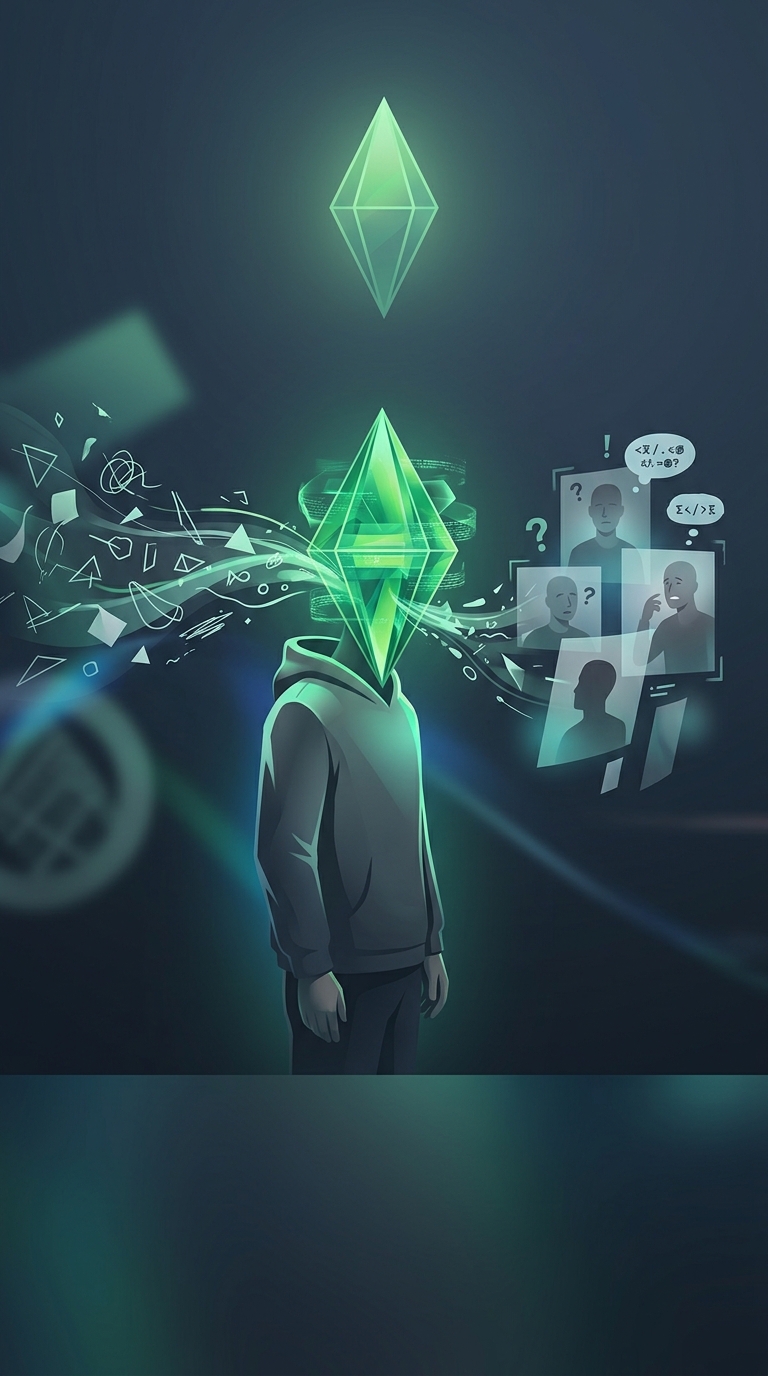
A language built for repetition
In The Sims, a character might greet a neighbor, complain about a meal, or flirt dozens of times over a long play session. If those lines were spoken in English, players would quickly recognize the same phrases—and the game would have to translate and record them for different markets. A made-up language offered a practical way around both problems.
But the goal was not merely to save on translation. English dialogue would also pin down what a character was saying. In a game where players direct the action, a line with a precise meaning could clash with what they imagine is happening. Simlish leaves room for that interpretation: a rising, excited-sounding burst might fit a joke, a celebration, or a conversation whose details the game does not spell out.
Meaning comes from the performance
Simlish is not a coded language with a dependable English translation for every phrase. Its words are largely invented, while tone, rhythm, facial expression, and the situation supply the meaning. A player can tell that a Sim sounds irritated or pleased without needing a literal transcript.
That puts unusual demands on the voice acting. Performers have to make unfamiliar syllables sound emotionally legible, and the game’s animations and social context help complete the message. The result is speech that feels more varied than a small set of English lines, even as the same recordings recur.
The player fills in the conversation
The design choice turns a limitation into a feature. The game can reuse expressive vocal performances without forcing every player to hear the same explicit sentence in their own language. Players supply the imagined words themselves, guided by what their Sims are doing.
So when a Sim chatters over breakfast, the scene can feel specific without the game spelling out the conversation. The language stays deliberately open-ended—and that makes the player a quiet co-writer of ordinary moments.