Three crankshafts around one triangle
The Deltic’s name comes from the Greek letter delta: viewed end-on, its three banks of cylinders form a triangle. At each corner sits a crankshaft, the rotating shaft that turns the pistons’ motion into power. Gears synchronize the three shafts so they work together.
Inside each cylinder, two pistons move toward and away from one another. This opposed-piston arrangement does away with a conventional cylinder head, helping make the engine unusually compact for the power it could produce. That mattered in a fast boat, where engine-room space and weight were precious.
From boat engine to locomotive power
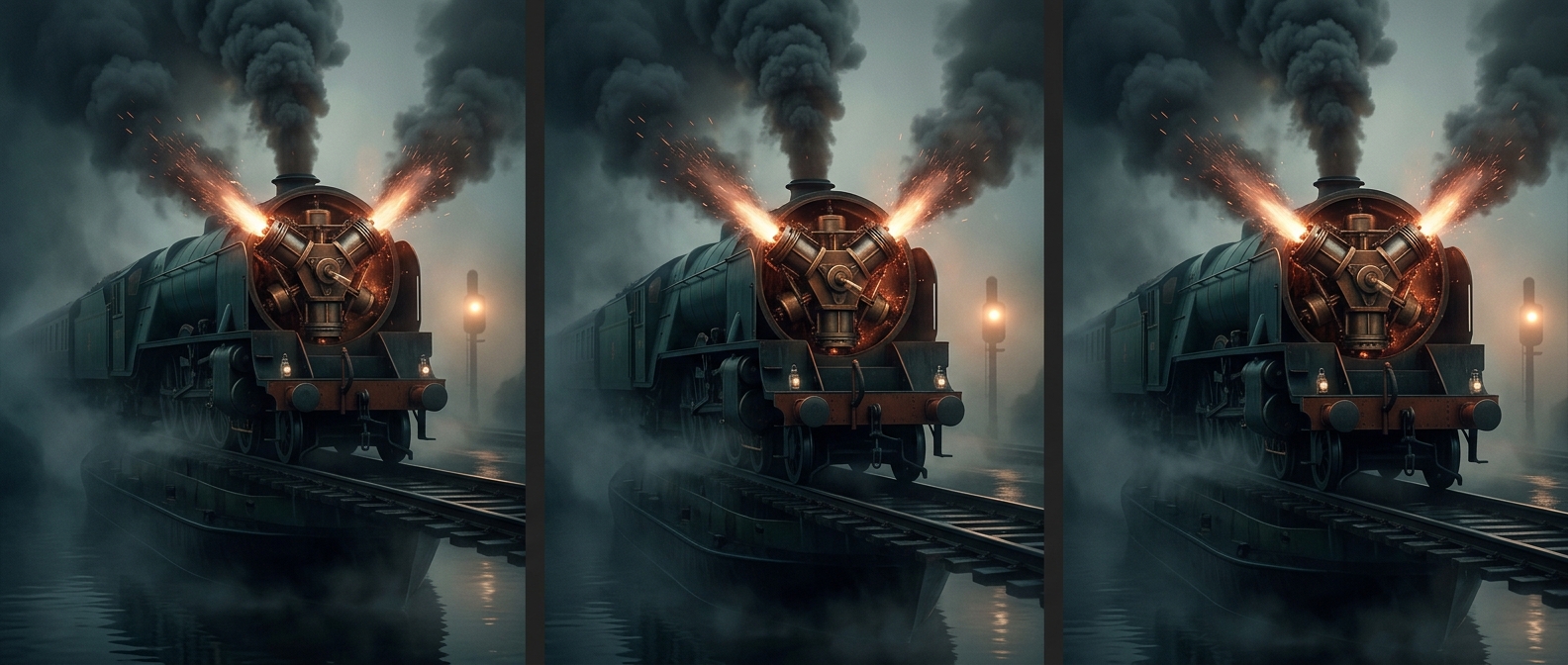
The design was developed for the British Admiralty’s need for powerful, space-conscious engines for small naval craft, including torpedo boats. Its marine origins did not mean it could simply be bolted to a train’s wheels, however. British Railways’ Deltic locomotives used the engines to generate electricity; electric traction motors then turned the wheels. This diesel-electric setup let a high-output engine power a heavy locomotive without a mechanical drive running all the way to the axles.
The railway version used two Deltic engines in one locomotive. Their compactness made it practical to carry that much power in a single body, helping the locomotives take on fast passenger work. The striking twist is that the train did not just inherit a boat engine: it inherited a design shaped by the same constraint—how to get substantial power into a limited space.