How a waterjet turns engine power into motion
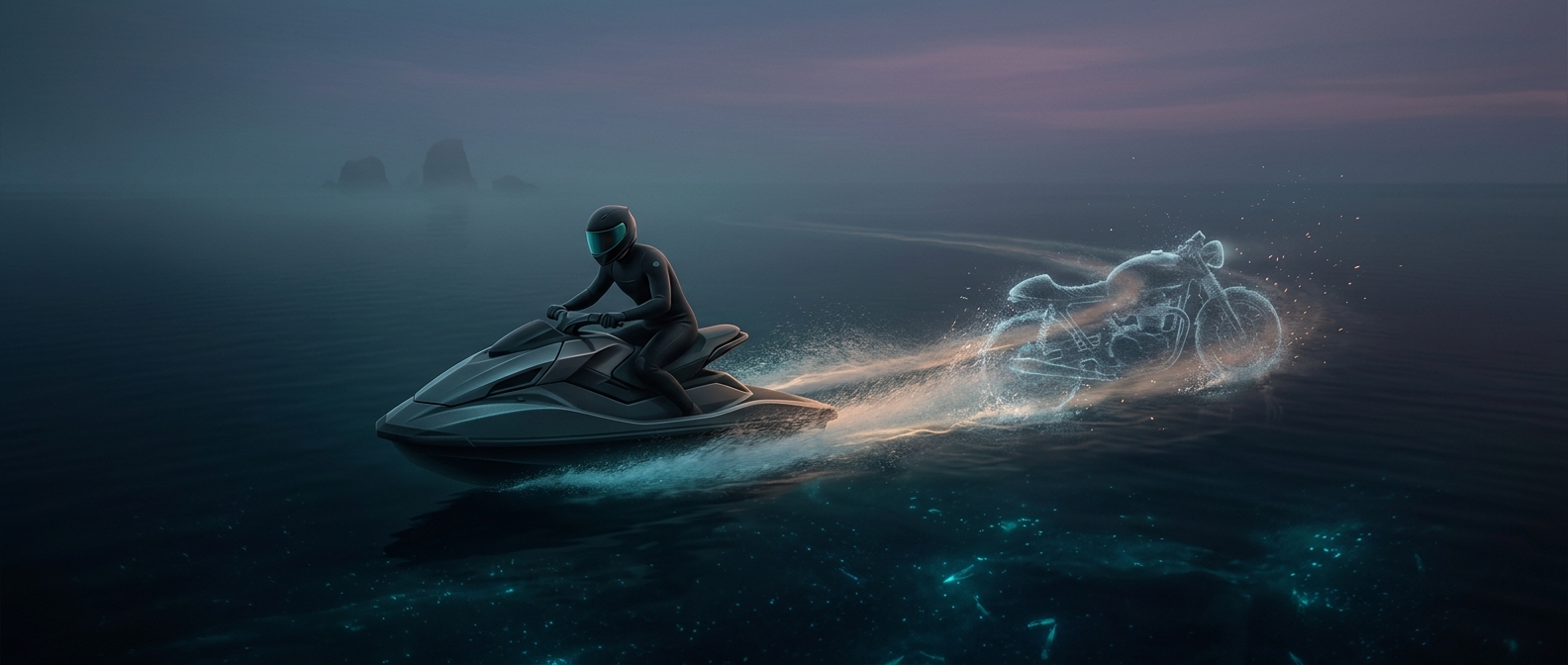
A personal watercraft draws water through an opening in its underside. Inside, an engine spins an impeller—a bladed rotor that works like a pump—forcing the incoming water through a narrower passage and out a nozzle at the stern. The fast-moving stream carries water backward; the craft is pushed forward in response.
That arrangement replaces the exposed propeller found on many boats. The impeller is enclosed inside the hull, and the nozzle concentrates the flow into a directed jet. The engine’s power therefore becomes a moving stream of water rather than the rotation of a propeller in open water.
Why steering depends on the jet
The handlebars move the nozzle from side to side. When the nozzle points right, the water jet is deflected right and the craft’s stern is pushed left, swinging the bow right. The same principle works in the other direction: steering comes from redirecting the thrust that is already moving the craft.
That creates an important handling difference from a car, whose front wheels can turn even when the vehicle is coasting. A waterjet craft needs water flowing from the nozzle to steer effectively, so reducing engine power also reduces the force available to turn. In practice, riders steer by managing both direction and throttle—not by aiming a separate rudder into the water.
The nozzle is thus more than a control surface: it is the final link between the engine and the craft’s path. Wherever that stream is aimed, the machine is pushed the other way.»