How an Empty Place on a Chart Gets a Meaning
In midpoint astrology, two chart positions are treated as ingredients in a third. Their midpoint is the zodiac position halfway between them: if one point is at 10 degrees and another at 20 degrees of the same sign, the midpoint is at 15 degrees. Because the zodiac is a circle, astrologers also have to decide which halfway route they mean when the points are far apart.
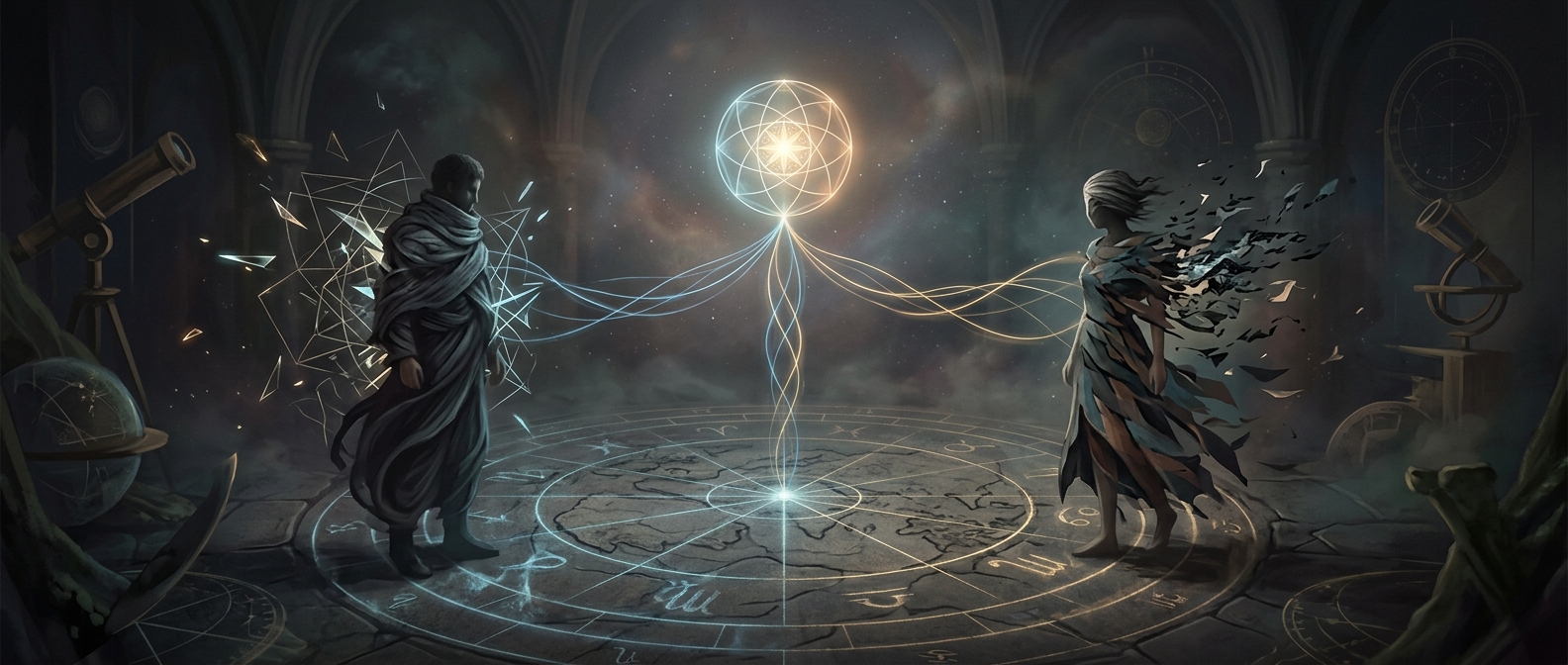
That calculated position does not need to contain a planet. It can still be read as a symbolic meeting point for the two factors. For instance, an astrologer might interpret the midpoint between the Sun and Moon as blending themes associated with identity and emotional needs. The chart’s blank space, in other words, becomes a place where a relationship between two points is said to show up.
Why the Method Can Multiply Worries
The method creates more interpretive combinations than simply reading the planets one by one. Each new midpoint offers another possible pattern to examine—and another possible explanation for a problem. A person already inclined to scrutinize a chart can find that even the absence of a planet does not end the analysis; the arithmetic supplies a new point to think about.
This is an astrological interpretive practice, not a demonstrated way to diagnose personality or predict events. Its appeal lies in the system’s internal logic: two chart factors are combined, a precise location is calculated, and that location is given a meaning. The joke is that a chart can run out of planets before it runs out of things to worry about.