How R2-D2 Speaks Without Words
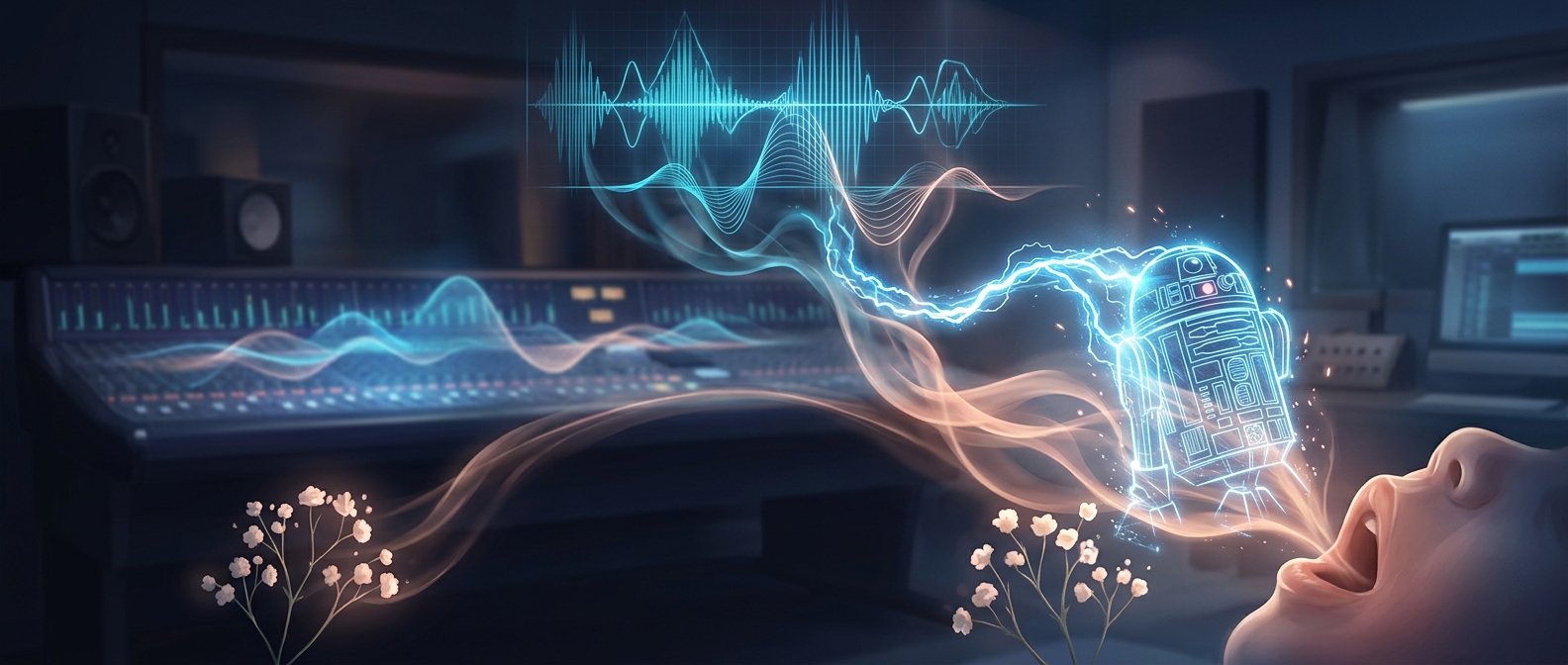
R2-D2 needed to communicate, but giving the droid ordinary dialogue would have changed the character: a speaking robot could explain itself, while a beeping one leaves room for the audience to read its reactions. Sound editor Ben Burtt solved that problem by blending electronic tones with baby-like vocal sounds. The result can suggest alarm, curiosity, or reassurance without forming sentences.
A Human Voice Inside an Electronic Sound
Burtt’s coos supplied something a synthesizer alone might lack: the irregular, breath-like inflections of a living voice. The ARP 2600, an analog synthesizer that generates and shapes electronic tones, supplied the distinctly mechanical beeps. Put together, the sounds occupy a useful middle ground. R2-D2 feels like a machine, yet his noises have enough vocal character to seem responsive.
That balance lets the audience understand the droid through timing and tone rather than literal words. A quick, high burst can register as excitement; a drawn-out or wavering sound can feel more uncertain. The sounds do not have fixed dictionary meanings. Their emotional force comes from how they are shaped and from what R2-D2 is doing in the scene.
Why the Blend Matters
The voice is therefore not just a collection of memorable effects. It is a storytelling tool: it gives a small, nonverbal character a recognizable personality while preserving the sense that he is an electronic device. The next time R2-D2 answers another character, listen for both sides of the design—the machine’s beeps and the surprisingly human quality tucked inside them.