Why a planet seems to backtrack
Watch Mars against the distant stars over several weeks and it may appear to slow, pause, and move backward before resuming its usual direction. The stars are so far away that they provide a nearly fixed backdrop; the apparent change comes from our moving viewpoint, not from Mars turning around.
Earth and Mars both travel around the Sun, but Earth follows the inner, faster orbit. As Earth catches up with and passes Mars, our line of sight shifts across the background stars. That changing perspective makes Mars appear to drift backward for a time—much like a nearby car seeming to slide backward against distant scenery when your car passes it. The planet keeps moving forward along its orbit throughout.
A loop drawn by changing perspective
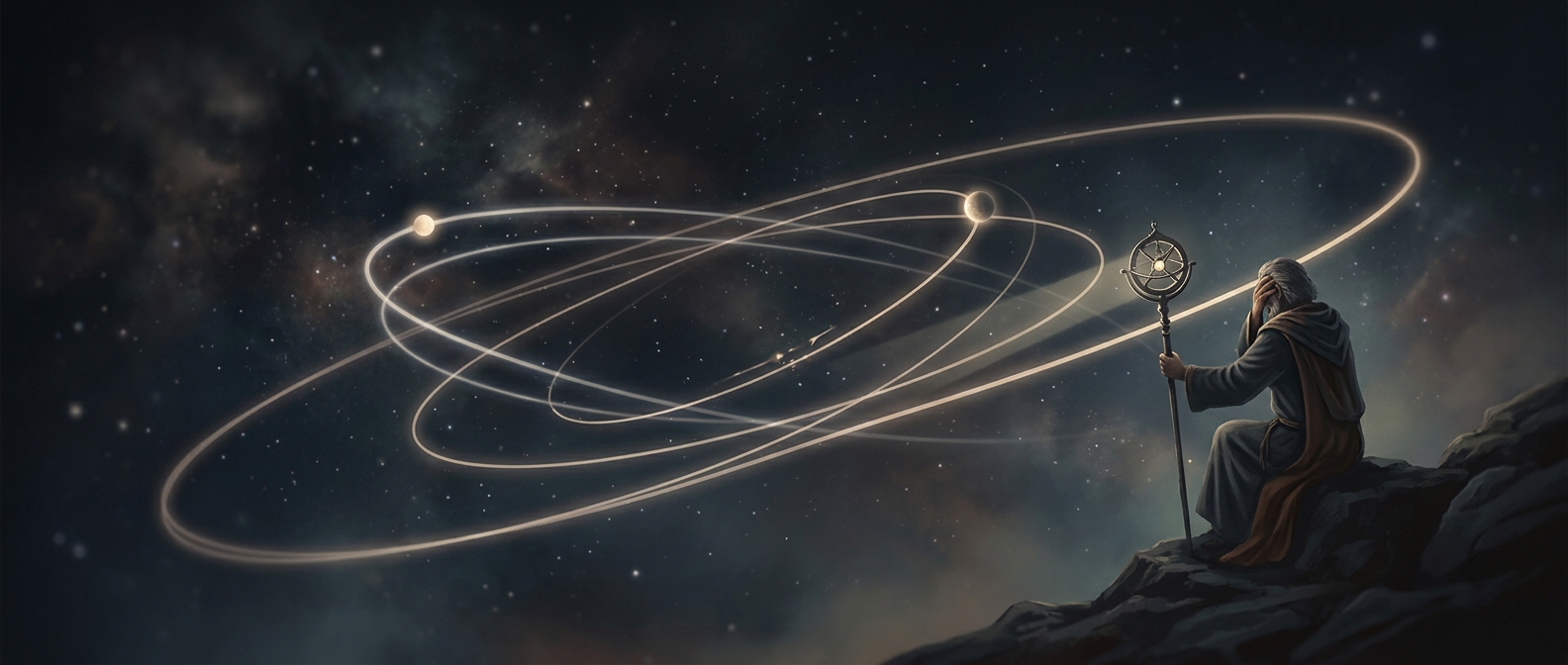
Because the planets’ orbits are tilted slightly relative to one another, their apparent paths do not always trace a simple straight back-and-forth line on the sky. A planet can seem to make a loop or a kink. The shape and timing depend on where Earth and the other planet are in their orbits.
The same general effect applies to the inner planets, Mercury and Venus, though their apparent reversals occur as they pass between Earth and the Sun. In every case, “retrograde” describes a temporary change in a planet’s apparent direction across the sky, not a reversal of its orbit.
Why the distinction matters
The apparent motion is real as an observation: a planet’s position against the stars does shift backward. What it does not reveal is the planet changing course. Retrograde motion is a perspective effect produced by planets moving at different speeds around the same Sun.