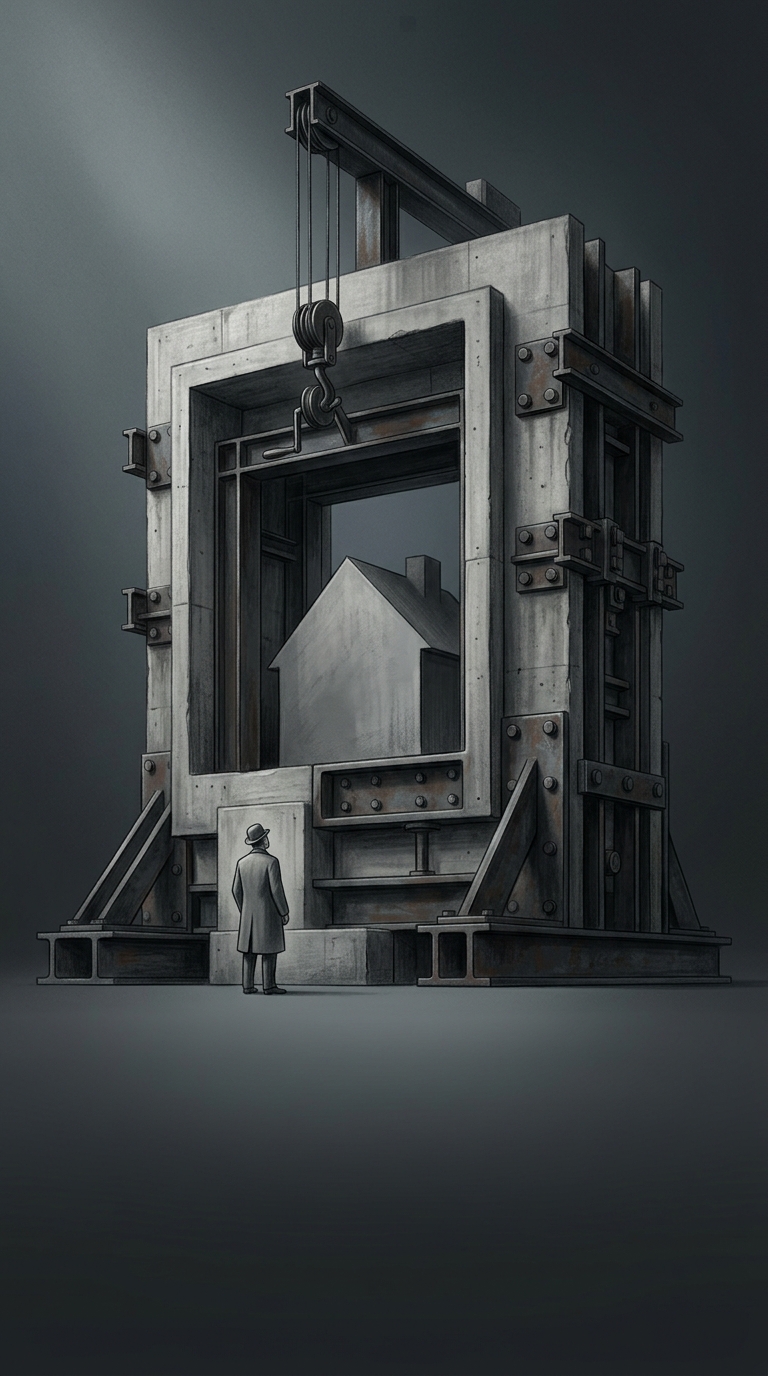
Edison’s one-pour house was an engineering shortcut with a costly catch
In 1908, Thomas Edison proposed building a house by pouring concrete into a large, reusable mold. The idea was to replace much of the slow, skilled work of assembling a home piece by piece with a single operation: fill the mold, let the concrete harden, then remove the form. If the same mold could be used repeatedly, each additional house might take less labor and less time.
The design aimed to cast walls, floors, roof, and other parts as one continuous structure. That promised fewer joints—the seams where separately made pieces meet—and a sturdy shell built in a day. But pouring concrete into a house-sized shape was not like filling a simple box. The form had to hold wet concrete in place, preserve the openings and interior spaces, and come apart after the material set. Edison’s mold used more than 2,000 interlocking pieces, turning the supposed shortcut into a complicated machine.
Reuse had to pay for the mold
The business case depended on spreading the cost of that elaborate form across many houses. A builder would have to buy or obtain the mold, assemble and maintain it, and then use it often enough for the savings in labor to outweigh those expenses. That made the method most attractive to a producer building many similar homes—not necessarily to an individual household or a local builder constructing only a few.
Ordinary wooden houses had a practical advantage: their materials and construction methods were already familiar, and they did not require such a large specialized mold. So even if Edison’s system could speed up the pouring stage, speed alone did not make the finished house cheaper. The innovation shifted the expense from repeated construction work into specialized equipment—and the equipment cost too much to make the trade worthwhile.