A movie star was the starting point
When Midway began developing the game that became Mortal Kombat, the appeal of Jean-Claude Van Damme was practical as well as star-driven: his martial-arts films offered a ready-made model for a fighting game built around recognizable physical action. The early idea was to put the actor himself on screen, using digitized footage—recorded images of a real performer converted into game characters—instead of drawing every movement by hand.
Van Damme did not become the game’s lead. The team had to build a concept that could stand on its own rather than depend on one celebrity’s likeness and participation.
The pivot made room for an ensemble
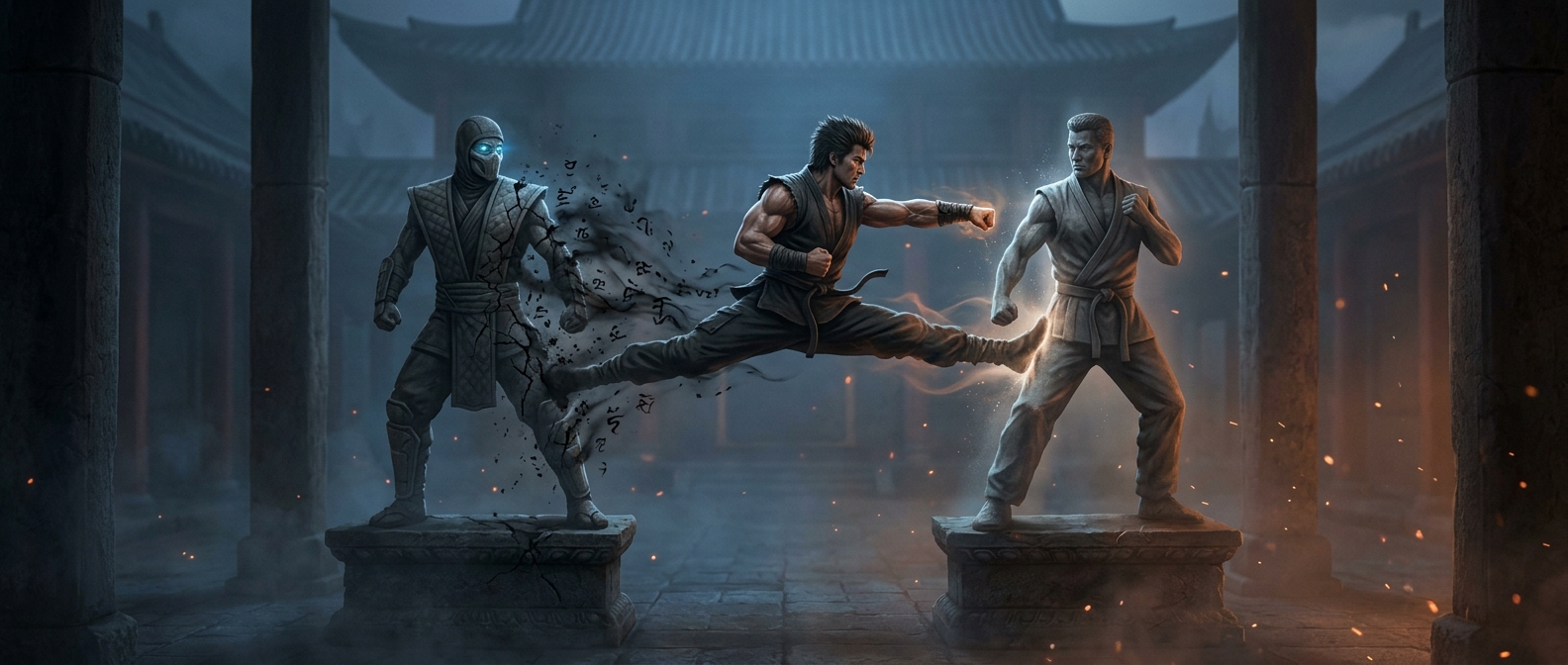
The result was a roster of original fighters, each with a distinct look and combat style. That change did more than replace one face with several: it gave the designers room to make the characters’ identities part of the game. Players could choose among fighters rather than simply control a movie star, and the tournament premise gave those rivals a reason to meet.
Digitized performers remained central to the visual approach. Real actors’ recorded movements gave attacks a bodily, recognizable quality, while the fictional cast let the game exaggerate those movements into distinct techniques and personalities.
A different kind of spectacle
The game’s signature finishing moves fit that shift toward a world with its own rules. Fatalities turned the end of a match into a dramatic payoff, not just a scoreboard result. The celebrity-driven pitch had become something more flexible: a fighting game whose cast, combat styles, and shock value could all be expanded without needing its original star.