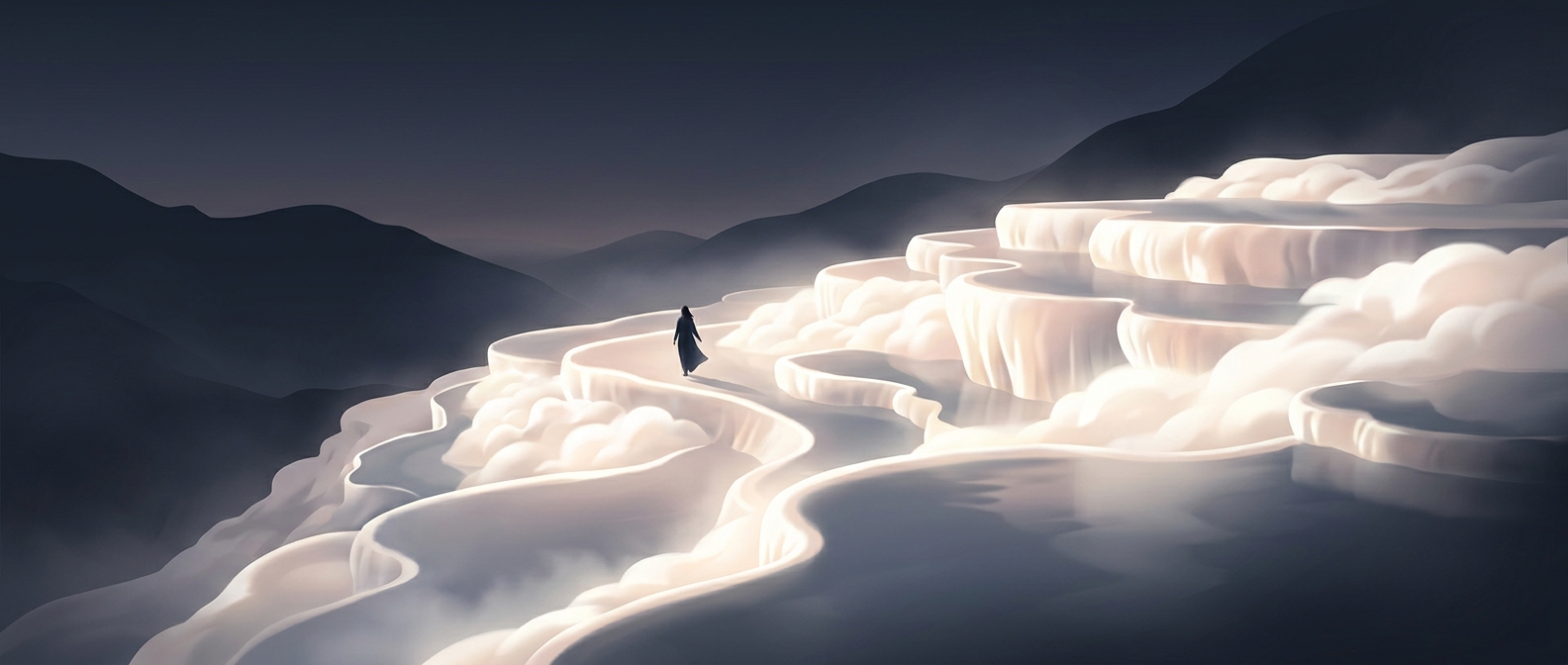
How the white terraces build themselves
Pamukkale’s pale slopes are made of travertine, a rock deposited from mineral-rich water. Underground, water picks up carbon dioxide, which helps it dissolve calcium carbonate from surrounding rock. When the spring water reaches the surface and spreads downhill, some of that carbon dioxide escapes. The water can then no longer hold as much dissolved mineral, so calcium carbonate settles out and hardens into a thin coating.
From flowing water to stepped pools
The process repeats wherever the water runs. Layer by layer, deposits thicken along the slope and create small rims. Those rims hold shallow water, forming basins; overflow spills to the next level, where more mineral can be left behind. The terraces are therefore not carved from a single block of white stone: they are built gradually by the spring’s flow.
Because the deposits are pale and the pools catch the sky, the surface can resemble snow even in a warm setting. The Turkish name Pamukkale means “cotton castle,” a fitting description of the soft, tiered outline.
A landscape shaped by a living spring
The terraces depend on water continuing to move across them. As its route shifts, mineral is deposited in different places, so the slope is a product of ongoing change rather than a fixed formation. What looks like a frozen cascade is, in effect, a record of spring water repeatedly arriving, spreading, and leaving stone behind.