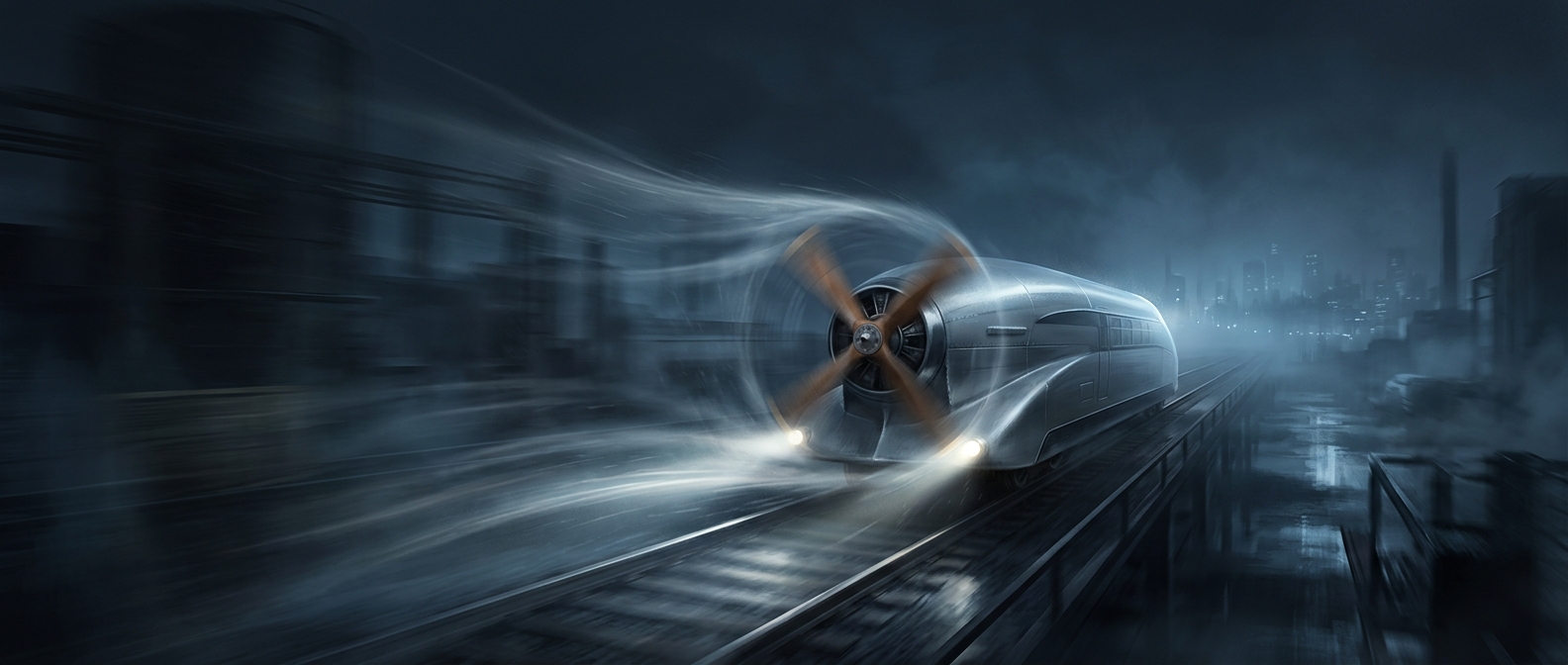
Why a propeller could move a railcar
The Schienenzeppelin was propelled not by its wheels but by air. An aircraft-style engine turned a propeller mounted at the rear, and the propeller’s thrust pushed the vehicle forward. Its wheels guided and supported it on the rails; they did not provide the main driving force.
That arrangement avoided the usual chain of locomotive, couplings, and passenger cars. It also shaped the vehicle’s design: a long, streamlined body reduced the air resistance that becomes increasingly important as speed rises. In 1931, the experimental railcar reached 143 mph, a striking demonstration of how fast a lightweight train-shaped vehicle could travel.
The speed came with a railway-sized problem
A propeller works well in open air, but railways are built around vehicles that can connect, stop, and operate among other trains. A rear propeller had to be kept clear of people and equipment, and its thrust was not transmitted through the wheels. That meant the Schienenzeppelin could not simply behave like an ordinary locomotive hauling a useful string of cars.
Wheel-driven trains have an important advantage: the wheels both move the train and grip the rails, letting the operator control that force through the vehicle’s contact with the track. With an air propeller, the push came from behind, while the wheels mainly rolled along. The record speed proved the concept could move quickly; it did not by itself solve the practical demands of regular railway service.
A record-setter, not a new railway standard
The Schienenzeppelin is remembered for testing a radical answer to a familiar engineering question: how might a train go faster? Its lesson was that top speed is only one part of transport design. A vehicle also has to fit the network around it—its stations, other trains, and the everyday work of carrying passengers. The propeller made the railcar extraordinary, but also made it unlike the trains the railway was built to run.