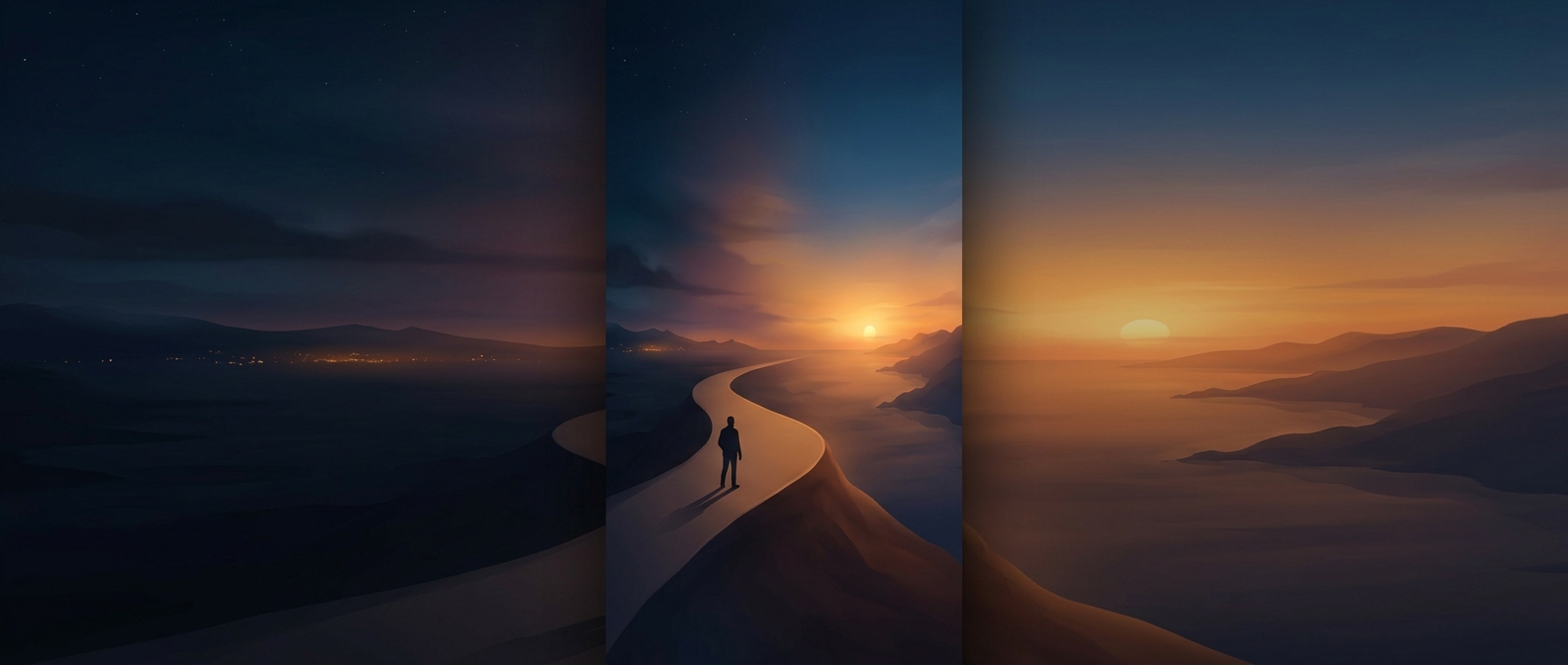
Why the day–night boundary is not a sharp line on the ground
From orbit, the boundary between Earth’s sunlit side and its night side is called the terminator. It looks like a line, but a traveler on the surface does not experience it as a sudden switch. Earth’s atmosphere bends and scatters sunlight, so the sky brightens before the Sun appears and remains lit after it drops below the horizon. Those twilight periods soften the transition between night and day.
Why sunrise times vary from place to place
The terminator’s position changes continuously as Earth turns, but the local sunrise also depends on where you are. A mountain can hide the Sun until it clears a ridge; a clear view over the sea may reveal it earlier. Latitude and season matter too: Earth’s tilted axis changes the Sun’s path across the sky, shifting both sunrise time and day length over the year.
Clock time adds another layer. Time zones divide the world into broad regions, while sunrise follows the Sun’s local position. Two towns in the same zone can therefore see daylight begin at different clock times, especially if they lie far apart east to west.
For travelers, the practical result is that “sunrise” is not just a time printed on an itinerary. The horizon, the season, and the direction of travel all shape when the first direct sunlight reaches a particular spot.