How Plotinus’s Papers Became the Enneads
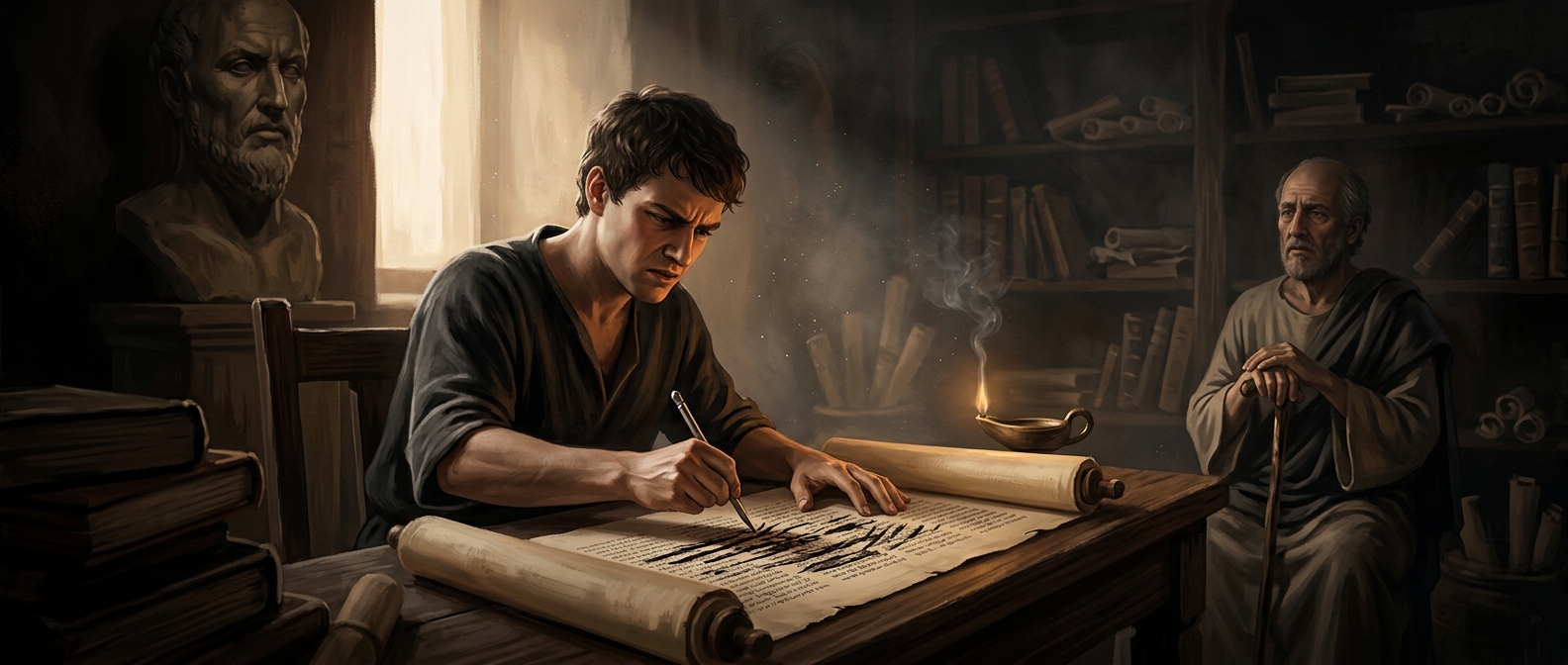
Plotinus did not leave behind a finished book arranged for readers. He wrote philosophical treatises as separate pieces, often in a compressed, winding style. According to his student Porphyry, poor eyesight made writing difficult for him, and he did not go back to revise what he had written. The result was a body of work that needed an editor before it could function as a coherent collection.
Porphyry Supplied the Structure
Porphyry gathered the manuscripts and arranged them into six groups of nine treatises. The title Enneads comes from the Greek word for “nines.” The grouping gave readers a way into Plotinus’s arguments, which range across topics such as ethics, the soul, intellect, and the source of reality.
This was more than tidying up a pile of pages. The order in which philosophical texts appear can shape how readers understand their connections. By choosing how to group the pieces, Porphyry made a path through ideas Plotinus had written separately. The collection preserved Plotinus’s words while giving them an architecture he had not supplied himself.
An Editor’s Choices Shaped a Legacy
Porphyry was both a student of Plotinus and the person who presented his writings to later readers. His editorial work helped turn private, difficult manuscripts into a body of philosophy that could be studied and taught. It also means that the familiar form of Plotinus’s work reflects two contributions: Plotinus’s arguments and Porphyry’s decisions about how to arrange them.
The Enneads thus preserve not a carefully revised book by Plotinus, but a student’s organized edition of his unfinished writings—a structure that helped those writings endure.