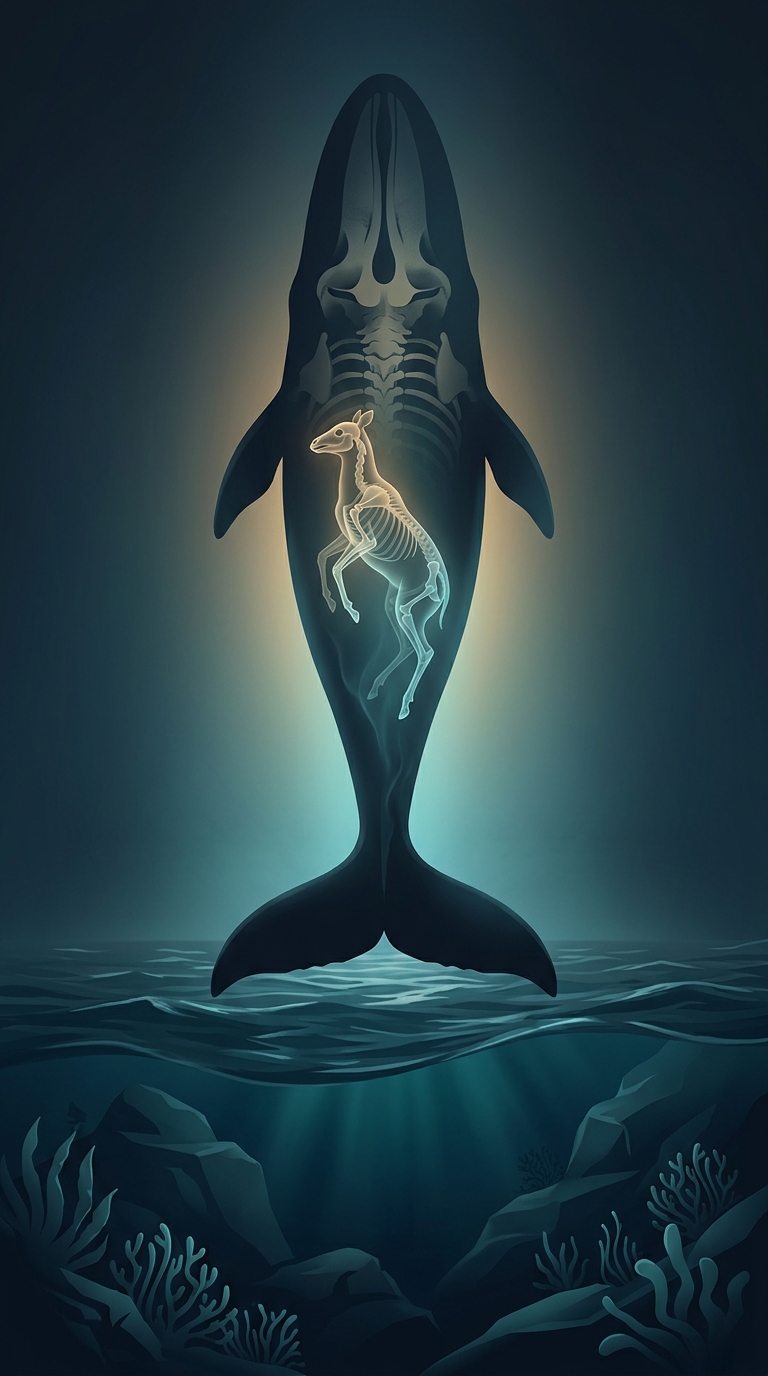
Before whales had flippers, they had four legs
The earliest known whale relatives were land mammals with bodies that would not look much like a modern whale. Some were roughly wolf-sized and walked on four sturdy legs; others were smaller and deerlike. They belonged to the hoofed-mammal branch of the family tree—not because whales descended from deer, but because whales and today’s hoofed animals share distant ancestors.
Fossils show the transition in stages. Early forms such as Pakicetus had legs suited to walking, but features of the skull and ear linked them to whales. Later whales spent more time in water. Their limbs and pelvis changed, their tails became the main source of propulsion, and their nostrils shifted toward the top of the head. Some intermediate fossils preserve both useful legs and adaptations for swimming.
A surprising cousin, not a direct ancestor
The closest living relatives of whales are hippos. That does not mean an ancient hippo turned into a whale: both groups evolved from a shared ancestor long ago, and hippos followed their own path. The resemblance between early whale relatives and other hoofed mammals reflects that broader kinship, not a simple ladder from one modern animal to another.
The change from land to water took millions of years, leaving fossils with combinations of old and new traits. A whale’s flipper began as a mammal’s limb; the rest of the body was reshaped as swimming became a better way to make a living.