A screen designed for experiments became a playfield
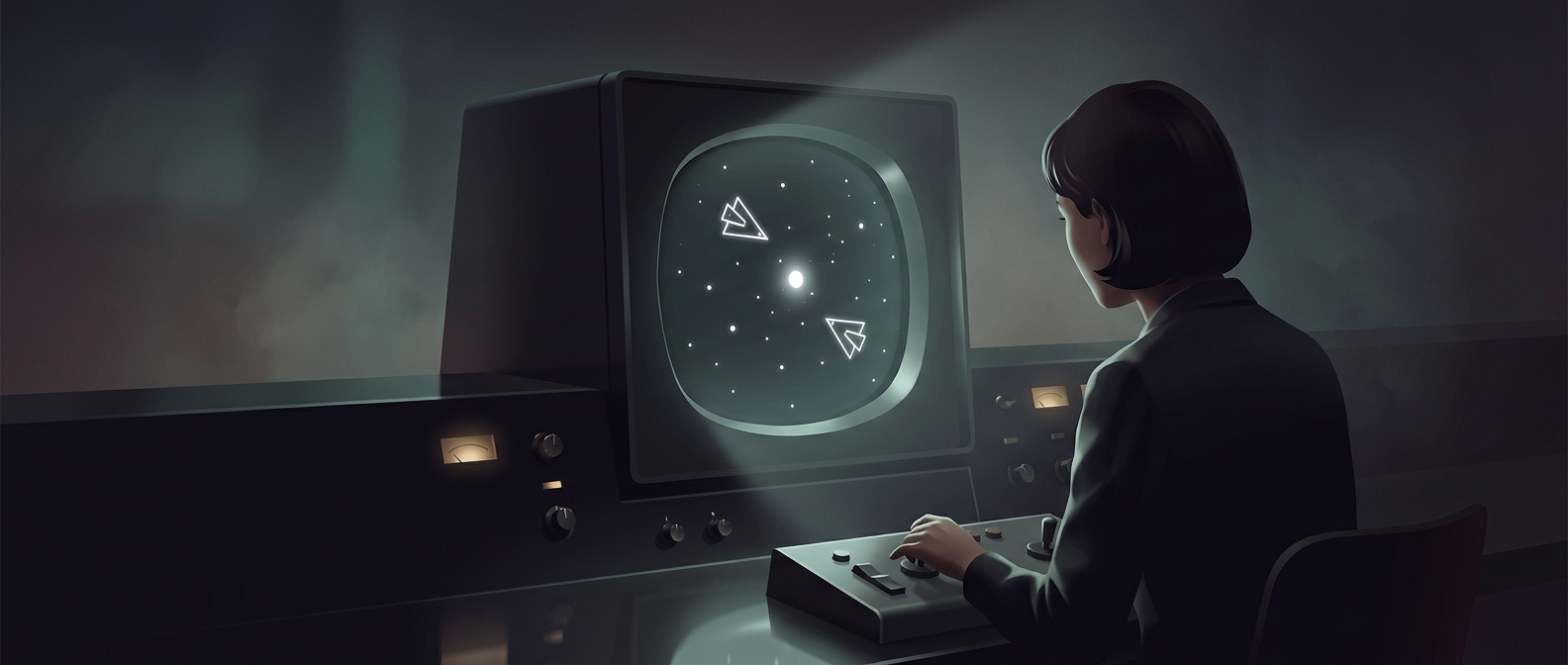
The PDP-1 was not a home computer with a screen added for entertainment. It was a room-sized machine built for interactive computing, with a cathode-ray display that could draw lines and points directly. That made it possible to show spaceships as simple outlines and move them in response to players’ controls—without needing the detailed images or stored animation a modern game might use.
That constraint helped shape Spacewar! rather than prevent it. The game’s ships were spare symbols, but their motion made them feel physical: players aimed and fired while steering through space, where a star’s gravity could bend a ship’s path. The display showed just enough for players to understand the danger and react.
A machine’s limits became part of the game
The PDP-1’s controls let two people play against each other, turning the computer from a device that mainly processed assigned tasks into something responsive and social. Each player had to divide attention between movement, aim, and the pull of the star. The challenge came from managing those competing demands in real time—not from elaborate scenery.
Because the game ran on a particular computer, it could not simply be passed around like a printed set of rules. Its spread depended on access to similar machines and on people willing to copy, adapt, and run the program at other institutions. In that sense, Spacewar! circulated through the same technical communities that used computers for research and experimentation.
The striking shift was not just that students made a game on an expensive machine. It was that an interactive computer could be treated as a shared playground: the screen’s crude lines, the machine’s responsiveness, and two players’ decisions were enough to make a new kind of entertainment.