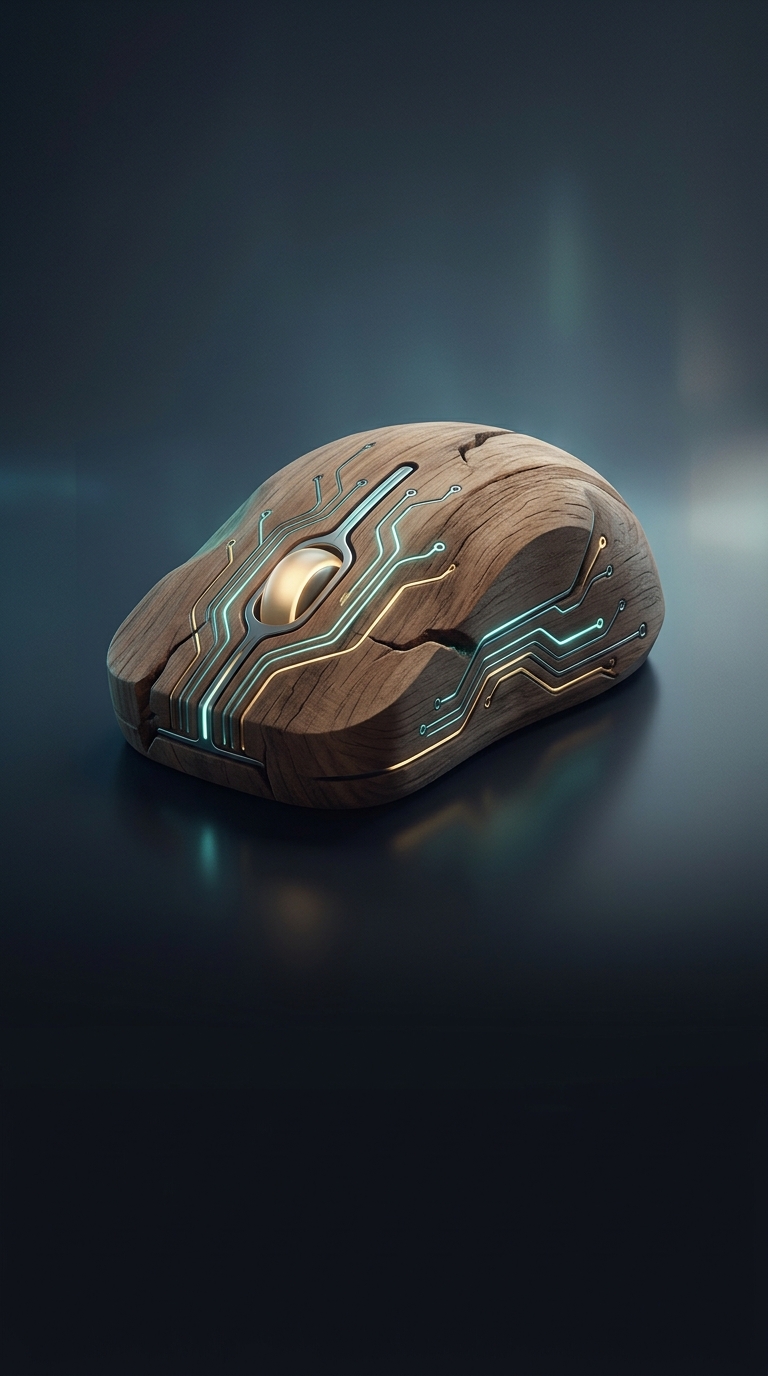
A wooden shell for a new way to point
The first computer mouse prototype had a hand-shaped wooden case. Douglas Engelbart’s team developed it in the 1960s, when interacting with a computer often meant typing commands or using specialized controls. The wood was a practical casing for an experimental device—not a design flourish. Its purpose was to let a person move a pointer on a screen by moving a small object across a desk.
Two wheels translated motion into direction
Inside the prototype, two metal wheels sat at right angles to each other. As the user slid the box, one wheel turned with horizontal movement and the other with vertical movement. The computer could use those separate signals to move the on-screen pointer in the matching direction. A button on top let the user select an item.
That arrangement made the mouse more than a convenient handle: it linked a familiar hand motion to a change on the display. The wooden casing enclosed a compact mechanical system that turned movement on a desk into instructions a computer could interpret.
From experiment to everyday interface
The prototype was not the polished, mass-market mouse people know today. Its significance was the interaction it demonstrated: instead of describing a location through typed commands, a user could point directly at something on the screen. Later designs changed the mechanism and materials, but the original’s wood-and-wheel construction captures how hands-on the early experiments in personal computing were. Before the mouse became an ordinary plastic peripheral, it was a wooden box with two wheels—and a new idea about how people could communicate with computers.