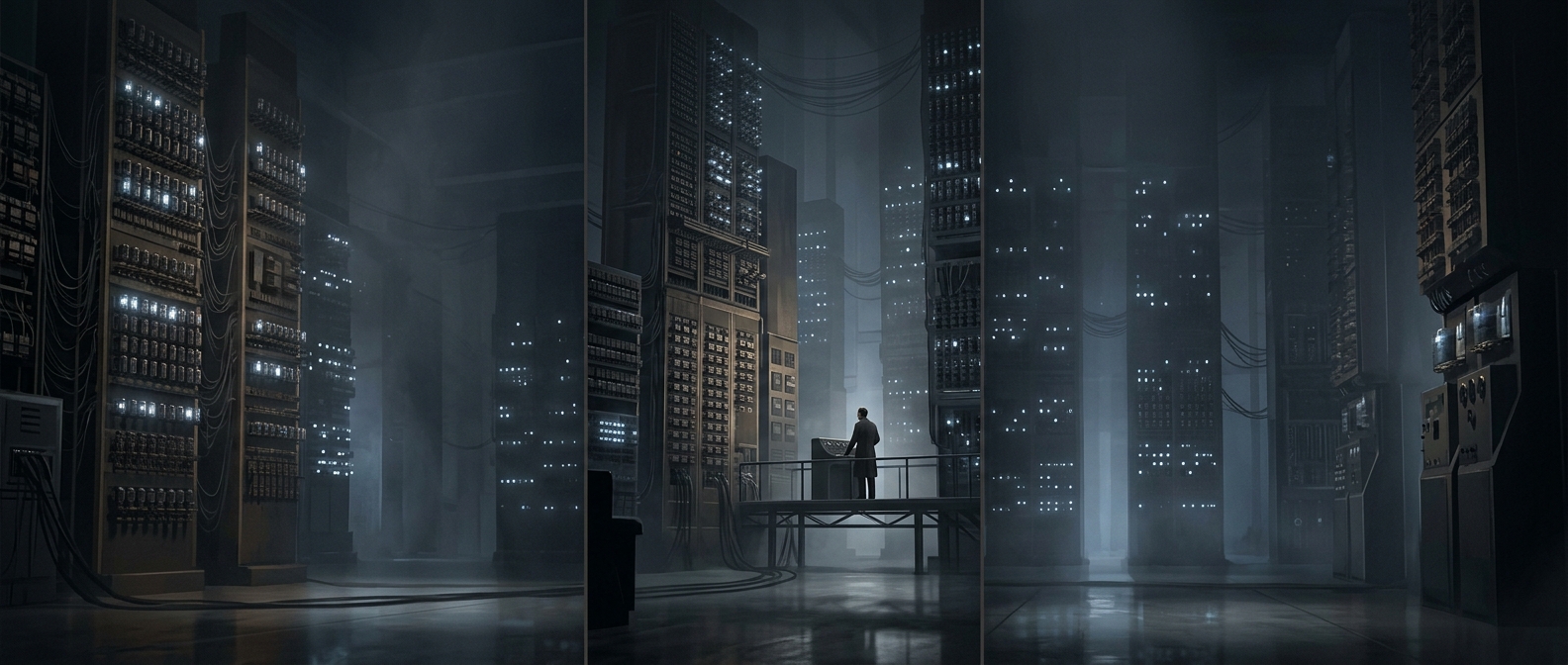
Why ENIAC needed a room of its own
ENIAC’s size came from the hardware required to make calculations electronically in the 1940s. Its basic components were vacuum tubes: glass devices that controlled electrical signals and could switch rapidly between states. Thousands of them, along with wiring, switches, and other equipment, had to be installed and kept working. Unlike a modern computer, ENIAC had no compact chips; its computing elements were large, separate physical parts.
Those tubes let ENIAC perform arithmetic far faster than a person working by hand. The machine was built for the U.S. Army to calculate artillery firing tables, which showed how to aim guns under different conditions. Faster calculations could help produce those tables sooner—but speed at arithmetic did not mean the machine was easy to give new tasks.
Changing a program meant changing the machine
ENIAC did not store instructions in memory the way a typical computer does today. To set it up for a calculation, operators connected cables and adjusted switches, routing electrical signals through the machine in the required sequence. A new problem could require rewiring and checking those connections, so programming involved tangible, hands-on work.
That arrangement reflects an early stage in computing: engineers could build a machine that performed calculations electronically, but they had not yet made instructions as easy to change as numbers. ENIAC’s room-sized installation was therefore not just a bigger version of a modern desktop. It was a whole working system—computing circuits, control equipment, and the connections that told those circuits what to do.