When rotation became a psychiatric treatment
In an era when doctors had few effective ways to treat severe mental illness, some tried to act directly on the brain by moving the patient’s whole body. Their reasoning was physical: if mental disturbance came from an imbalance in the brain, perhaps vigorous motion could shift the fluids thought to be involved and restore order.
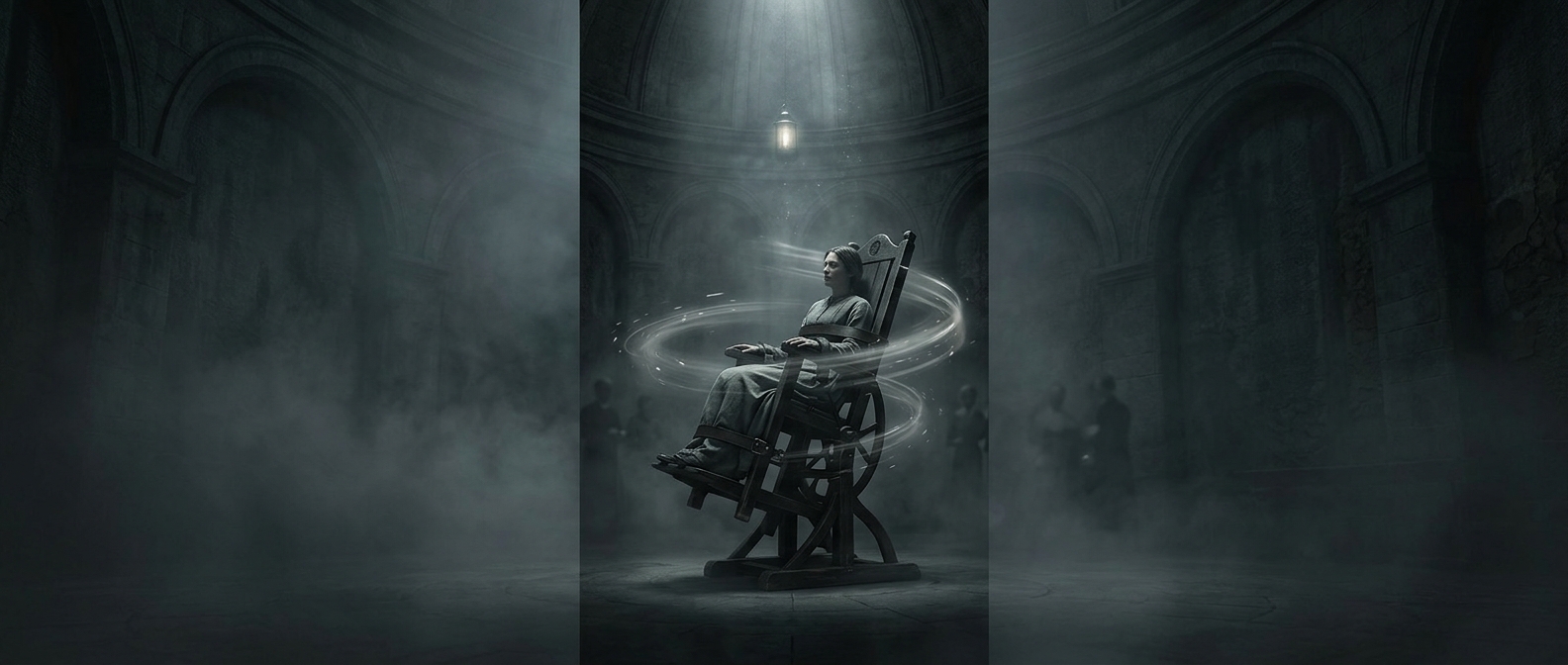
The rotating chair turned that guess into a procedure. A patient was strapped in and spun rapidly; the intended force was not simply to make the person dizzy but to produce a powerful bodily reaction, sometimes continuing until the patient lost consciousness. The patient’s body was treated as both the target and the test of the theory.
What spinning does to the body
The inner ear contains a motion-sensing system that helps the brain track how the head moves. Rapid rotation overwhelms those signals. The mismatch between what the inner ear reports and what the eyes and body register can cause intense dizziness, nausea, disorientation, and loss of balance. Extreme distress or physical strain can also lead to fainting.
Those effects were visible and immediate, which may have made the treatment seem forceful. But a dramatic reaction was not evidence that the underlying illness had been corrected. The theory about brain fluids was speculation, and the spinning itself could make a patient helpless or unconscious without resolving the condition that brought them to care.
The cost of treating a theory as a mechanism
The chair illustrates a consequential gap in early psychiatric practice: a confident physical explanation could motivate a treatment before doctors understood what the treatment was doing to the body. Instead of measuring whether a patient’s mental state improved in a lasting way, the procedure could make the body’s collapse look like proof that something had been achieved.
In this treatment, unconsciousness was not a sign that the brain’s supposed imbalance had been set right. It was the point at which the patient could no longer resist the experiment.