How a séance became a parlor game
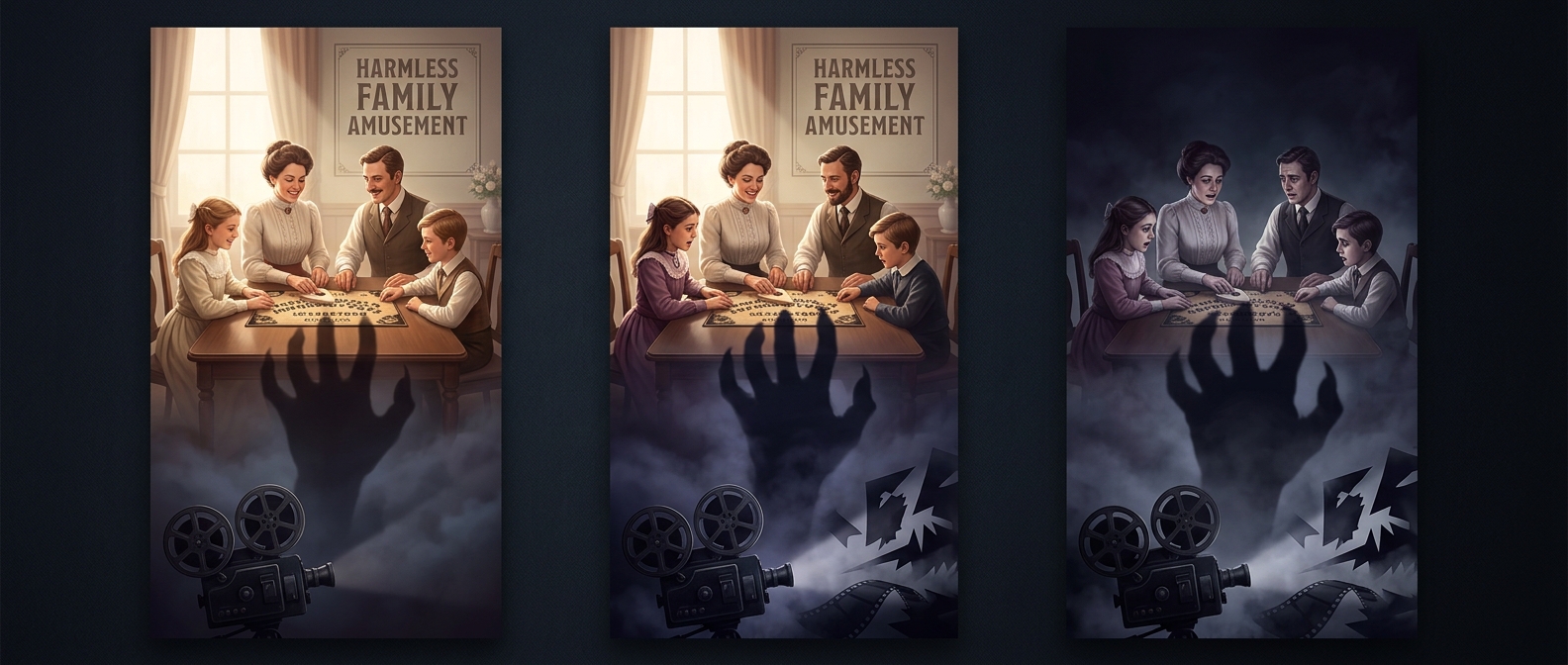
When Ouija boards entered the market in the late 19th century, they fit a culture already fascinated by spiritualism—the belief that the living could communicate with the dead. But the board was sold as entertainment, not simply as a solemn tool for mediums. Its printed letters, numbers, and “yes” and “no” spaces turned an eerie question—what might the unseen say?—into a game people could play around a table.
Players rested their fingertips on a small sliding pointer, or planchette, and watched it travel across the board to spell out answers. Because the movement felt as though it came from somewhere outside the players, the device made uncertainty part of the fun. A parlor gathering could become a guessing game, a spooky spectacle, or a flirtatious diversion for courting couples.
The pointer’s movement supplied the mystery
The planchette did not need a hidden force to move. When people lightly touch it, tiny, often unconscious muscle movements can guide it without any one player feeling responsible. This is known as the ideomotor effect: an action produced by expectation or thought without a conscious decision to make it. Around a board, each participant can feel the pointer move while no one seems to be steering it.
That ambiguity was the game’s engine. The board offered a simple, shared interface; the players supplied questions and interpretations. The same experience could be treated as a prank, a supernatural message, or an amusing way to spend an evening.
Horror changed the frame
The Exorcist, released in 1973, helped push the Ouija board toward a darker cultural role by linking it with a story of demonic possession. The contrast is striking: a familiar household game became an ominous signal that a character had opened a door to danger. The board itself had not changed, but the story surrounding it had.
That shift shows how much a game’s meaning can depend on its setting. In a lively parlor, a moving pointer could invite laughter and suspense; on screen, the same motion could foreshadow terror.