A Collection Is Also a Retrieval System
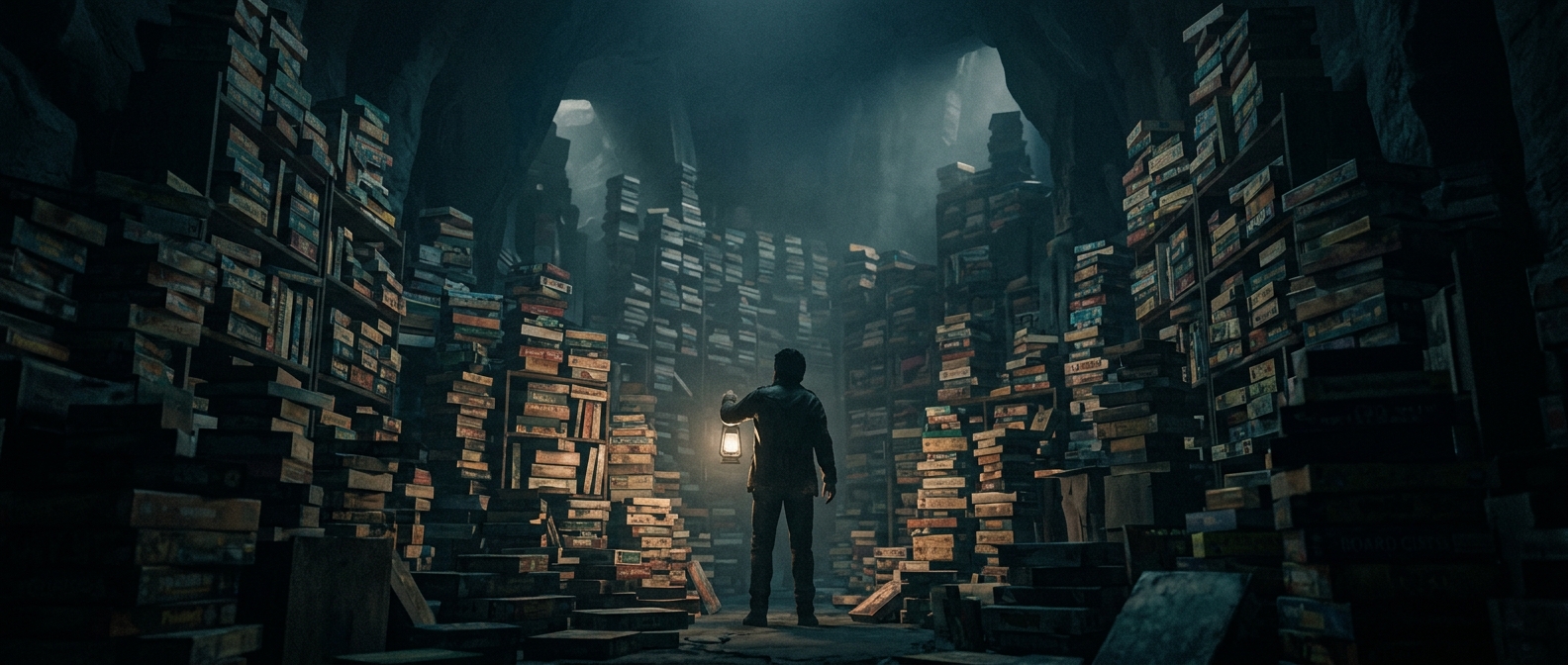
At this scale, the challenge is not simply finding room for boxes. A board game is a bundle of physical pieces—often a board, cards, tokens, and a rulebook—and boxes vary in size and shape. Shelving them tightly can save space, but it can also make a particular title difficult to locate without moving other games.
That turns organization into a practical problem of identification: each game needs a known place and a way to be distinguished from thousands of others. A catalog can help by recording titles and locations, while consistent shelf labels make the catalog useful in the room. Without some system, even an impressive collection can become a maze of boxes.
The Space Keeps Changing
Board games also differ in how much room they need. A compact card game and a large-box game do not fit the same storage pattern, and editions or expansions may add separate boxes or pieces. So the most efficient arrangement is not necessarily as simple as stacking everything by size: a system must balance space-saving with the ability to find and handle individual games.
The striking consequence is that owning 30,000 games involves more than preserving them. The collection has to work like a library, with enough structure to make its contents findable; otherwise, its sheer scale can hide the very games it is meant to keep.