How the climb loops back on itself
A Shepard tone is built from several tones whose pitches are separated by octaves. As they all slide upward, their relative loudness changes: tones near the middle of the audible range grow louder, while those near the extremes fade away.
That fading is the trick. When the highest tone nears the edge of the range, it becomes too quiet to notice; at the same time, a new tone enters at the bottom. The sequence can then repeat. Because the middle tones remain prominent, the ear follows a steady upward motion rather than noticing that the sound has quietly reset.
Why the ear hears an endless ascent
Pitch perception depends on more than one isolated frequency. The brain combines the tones into a single impression, and the changing loudness gives that impression a clear direction. Yet the octave-spaced layers leave no obvious point where the whole sound reaches a highest note and starts over. The perceived climb keeps moving even though the musical pattern is cycling.
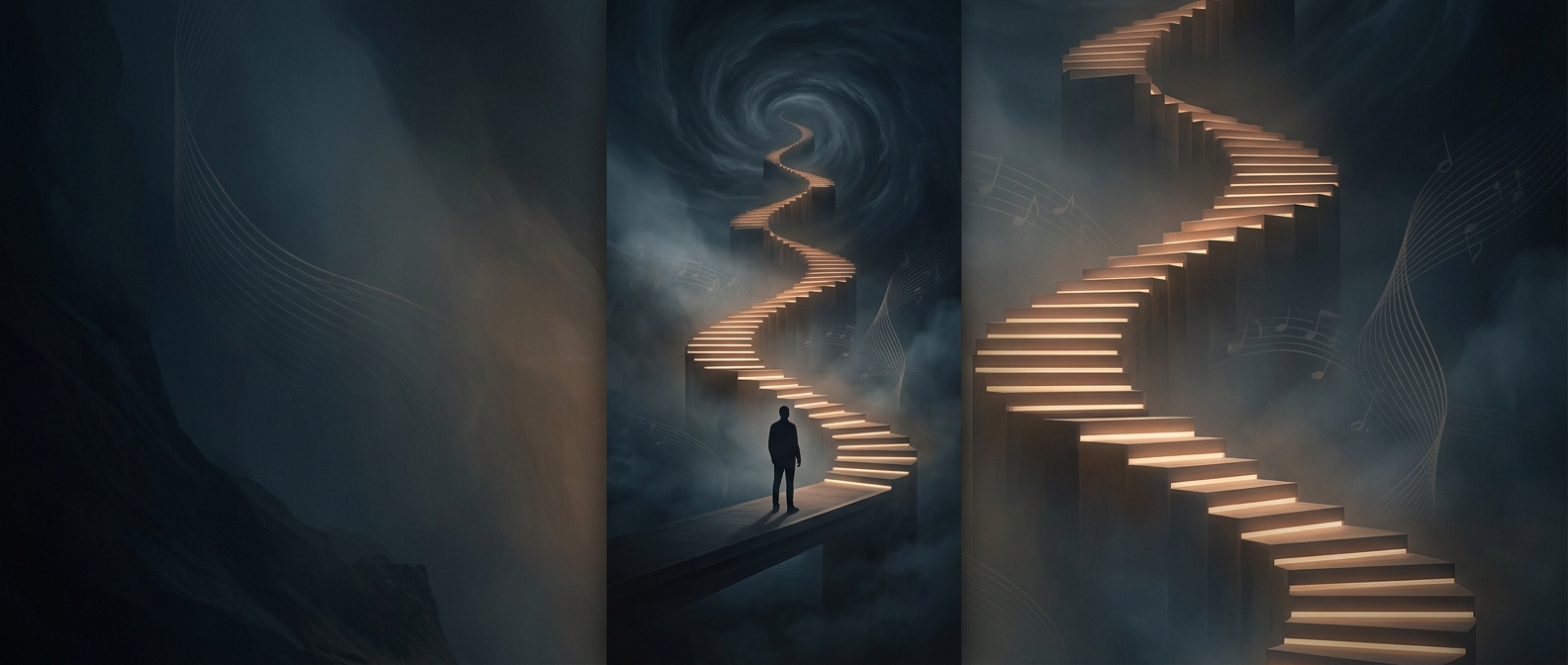
The effect is a close cousin of the visual staircase illusion, in which a connected path appears to rise continuously despite looping back. In sound, the handoff between fading high tones and emerging low ones is masked by the layers that continue in the middle.
A sound that can keep going
Composers and sound designers can use the effect to make tension feel as if it is building without relief. A short rising figure can be repeated, but the listener experiences it less as a loop than as an ascent with no arrival. The striking part is not that any one note rises forever; it is that the changing mix gives the ear enough continuity to imagine a staircase where the sound itself has no higher step.