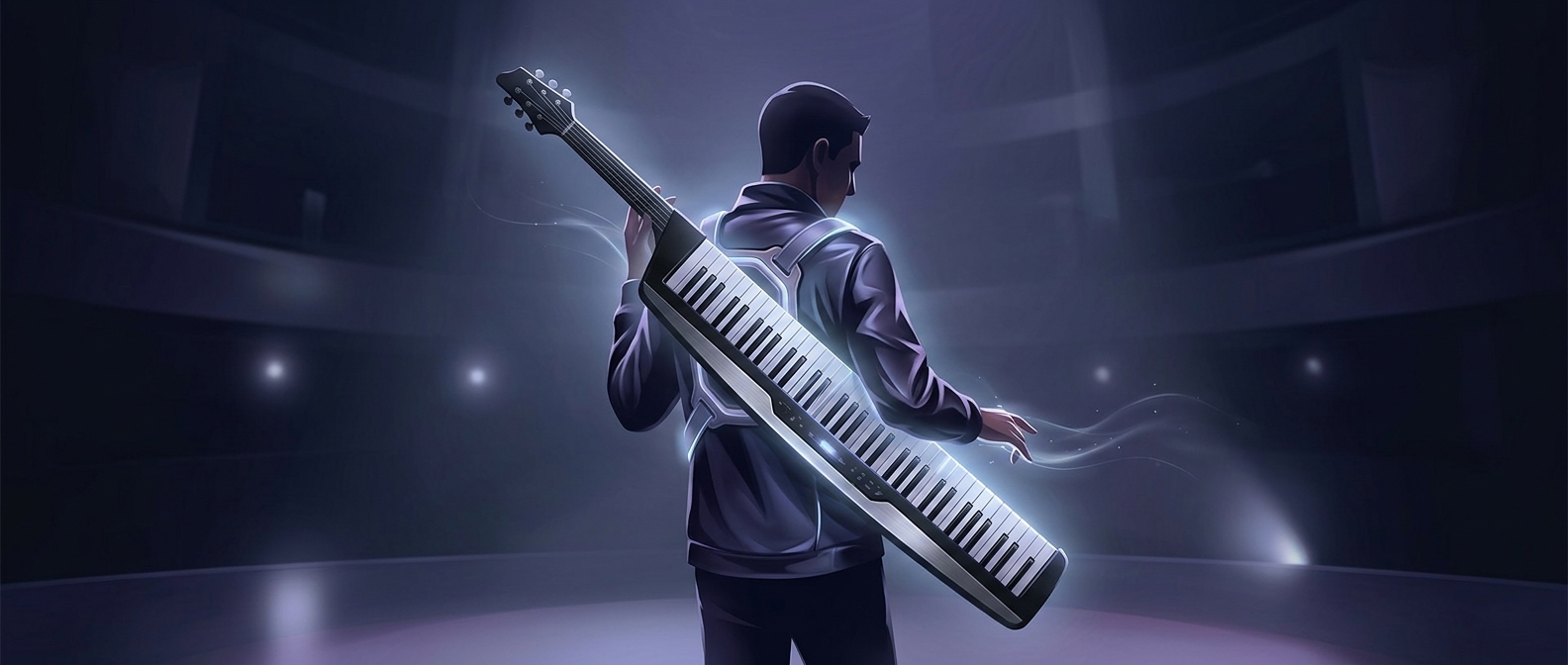
A keyboard built for movement
A keytar puts a keyboard on a shoulder strap, letting a player carry it across the body instead of standing behind a fixed instrument. The strap supports the instrument’s weight, so the player can step across a stage while continuing to play. Its shape keeps the keys in front of the hands, much like a compact keyboard held at an angle.
That freedom changes the performance, not the basic source of the notes: pressing a key still triggers a musical pitch. The player can move without leaving the keyboard behind, though walking and playing at once takes coordination—the instrument can shift or swing, and the hands still need to find the right keys.
Why the controls extend to the neck
Many keytars place extra controls near the neck, where a player’s fretting hand might rest on a guitar. A pitch-bend control raises or lowers a note smoothly after it begins, rather than jumping to another key. This can imitate the sliding pitch of a guitar or voice. Other controls may alter a sound in different ways, such as changing its tone or adding vibrato.
The layout lets one hand play notes while the other shapes them, making expressive gestures possible without reaching back to a separate keyboard panel. The neck is not what produces the notes; it gives the player somewhere convenient to control how those notes change.
A tradeoff between freedom and stability
A strapped keyboard makes a stationary instrument portable, but it cannot offer the same broad playing surface as a full keyboard stand. Its compact design and body-mounted controls favor movement and visible, hands-on performance. The keytar’s defining trick is combining keyboard notes with the physical freedom—and pitch-bending gestures—of an instrument carried onstage.