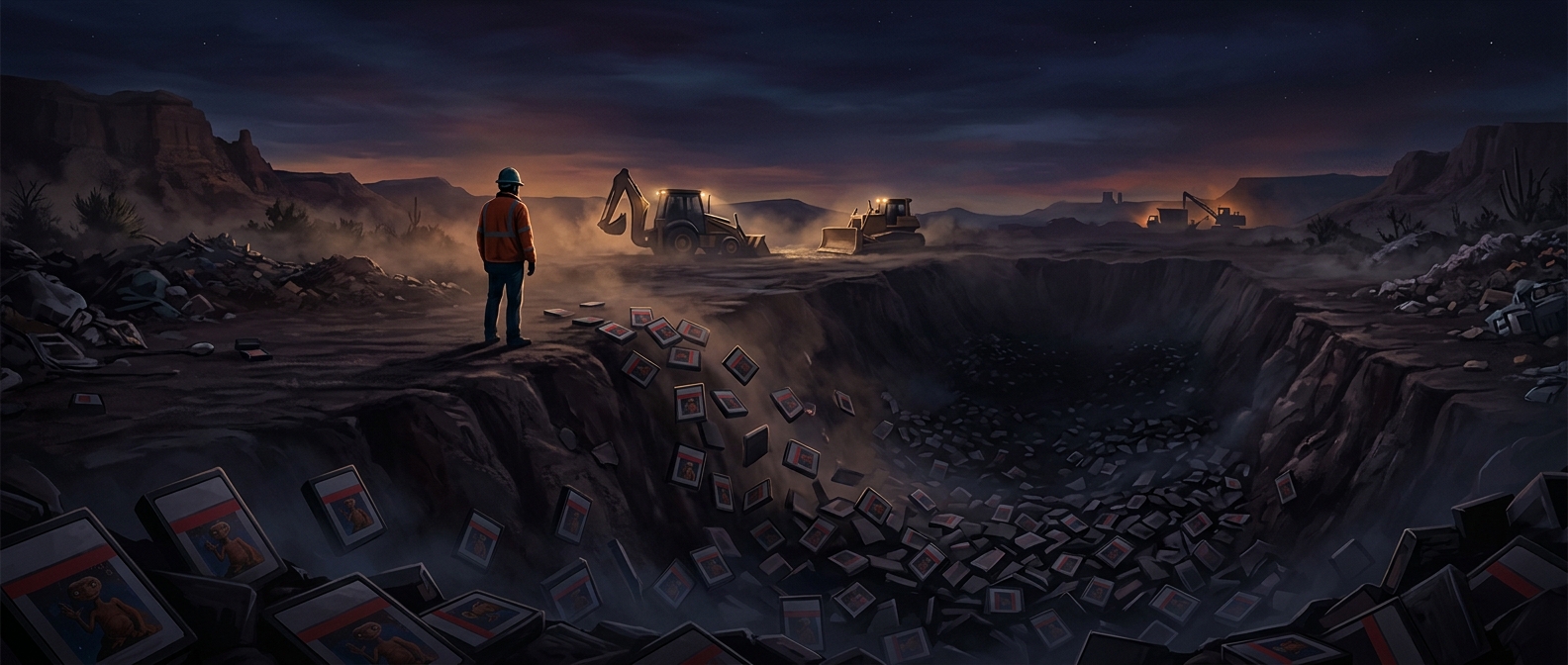
A Failed Release Became a Disposal Problem
Atari’s E.T. the Extra-Terrestrial was made on an unusually compressed schedule: its game was developed in about five weeks to reach stores for the 1982 holiday season. That left little time to refine the design, while Atari produced far more cartridges than customers ultimately bought. Unsold games tied up money and warehouse space, and cartridges could not simply be recalled and turned back into new products.
The company sent surplus inventory to a landfill in Alamogordo, New Mexico. The burial was not limited to E.T. cartridges: excavation later uncovered other Atari games and equipment as well. The scale of the disposal helped the episode grow into a story that Atari had buried millions of copies of E.T.—a claim more sweeping than what the excavation established.
What the 2014 Excavation Showed
For decades, the buried cartridges were part of gaming lore, and reports of the dump were often treated as an urban legend. In 2014, documentary filmmakers excavated the landfill and recovered Atari cartridges, including E.T. The find confirmed the core of the story while showing that the site held a mixed collection of discarded stock, not simply a mass grave of one game.
The episode became a concrete record of a mismatch between production and demand. Atari had made physical objects in enormous quantities for a hit it expected to sell; when those expectations failed, the leftovers had to go somewhere. The cartridges survived because a failed digital product still had weight, volume, and a disposal cost.