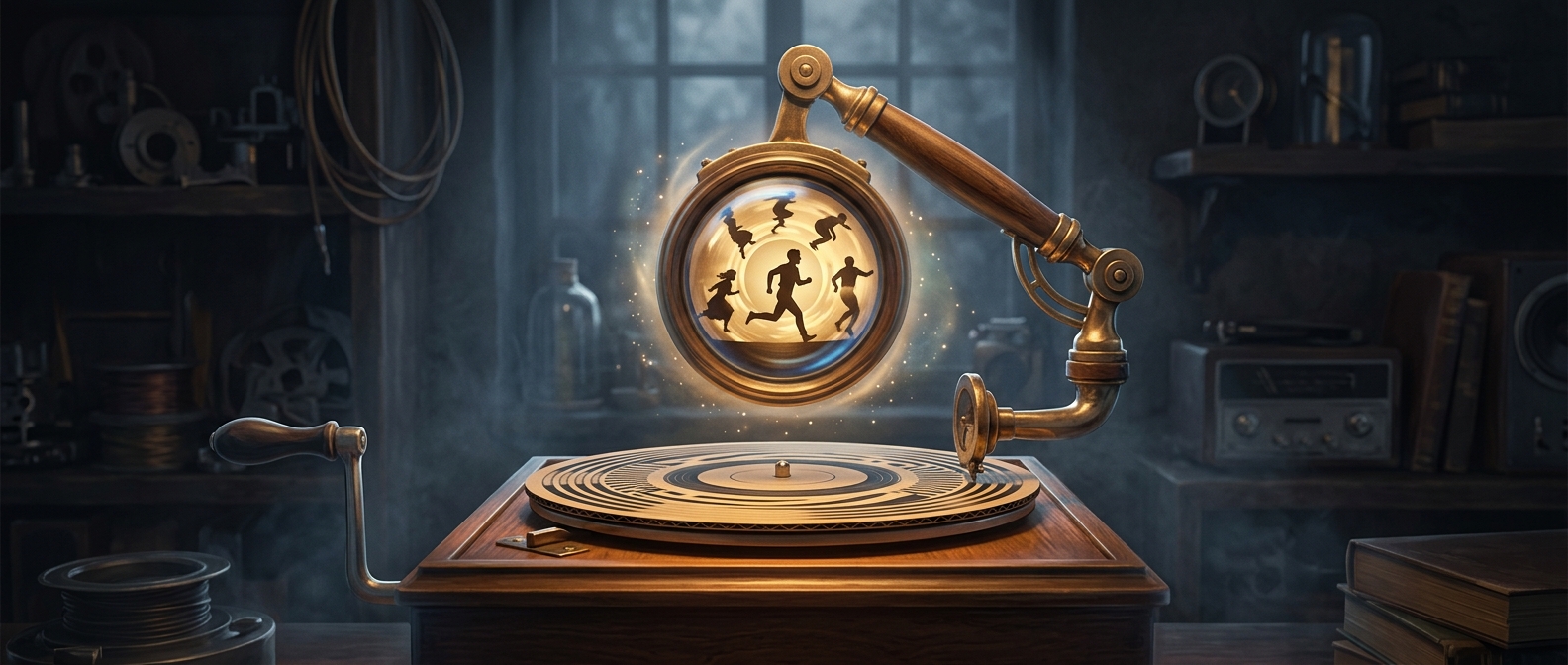
Turning a spinning disc into successive frames
A Phonotrope places a sequence of slightly different drawings around a rotating disc. As the disc turns, each drawing passes the same viewing position in order—much like frames moving through a film projector. The drawings themselves do not move; the rotation supplies the sequence.
The challenge is making those brief images appear steady rather than blur together. A camera’s shutter controls when it captures light. When the shutter opens in sync with the disc’s rotation, it records each drawing at the right moment, instead of smearing across the changing images.
Synchronization makes the motion readable
The timing is the key. If the shutter repeatedly catches the disc at matching positions, each exposure shows a successive drawing in the sequence. Played back in order, those still frames create the impression of motion. If the timing drifts, the sequence may seem to stutter, blur, or move at an unexpected pace.
That is the Phonotrope’s modern twist on the Victorian zoetrope, an early animation device that used a spinning cylinder and viewing slits to make drawings appear animated. Here, the camera shutter does the image-isolating work: it samples the rotating drawings at carefully timed intervals. A moving disc becomes a series of distinct frames, and the camera turns that timed sequence into a movie.