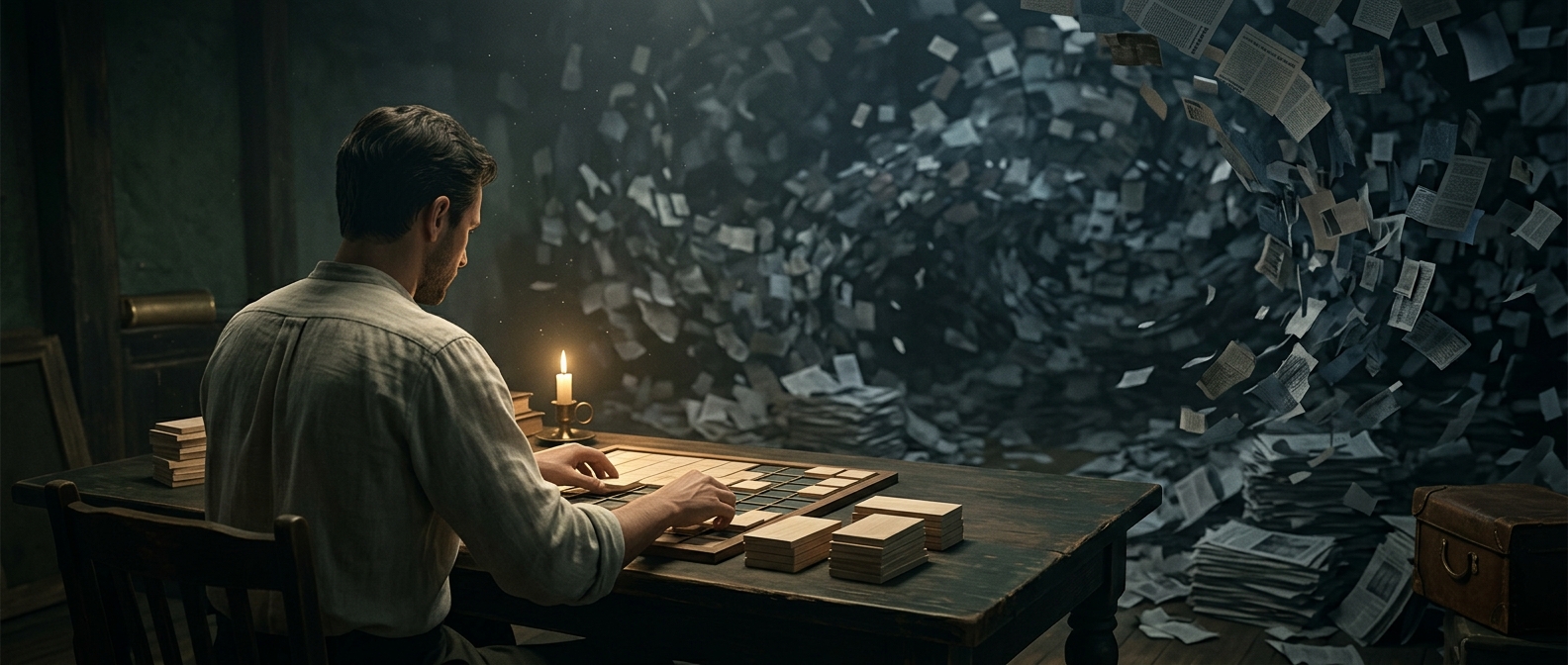
From newspaper letters to playable tiles
A newspaper’s front page offered an improvised sample of everyday written English. By counting its letters, Scrabble’s designer could compare how often the alphabet’s characters appeared, then use those proportions to guide how many of each letter to put in the game. The aim was not to turn every printed letter into a tile: the count was evidence for building a finite, reusable supply.
That distinction matters. A letter that appears often in ordinary writing needs enough tiles to be useful, while a rare letter can remain scarce. The resulting bag makes the language’s uneven letter frequencies part of the game’s equipment: players draw from the same limited pool, and their choices depend partly on what letters are likely to be available.
Frequency had to serve the game
A raw count could not, by itself, decide every design question. Scrabble also needs a workable mix on each rack: too many difficult-to-use letters can make turns frustrating, while making every letter plentiful would erase the challenge of finding a place for rarer ones. Tile counts therefore turn a practical observation about language into a playable balance of opportunity and constraint.
The method was hands-on and necessarily limited—a newspaper page is a sample, not a complete measurement of the language. But it connected an abstract design problem to something the designer could inspect directly: the letters appearing in print. Every time a player draws a tile, that early counting exercise is still present in miniature, shaping which words can be made and which are just out of reach.