Why the Defender’s Guard Can Point the Wrong Way
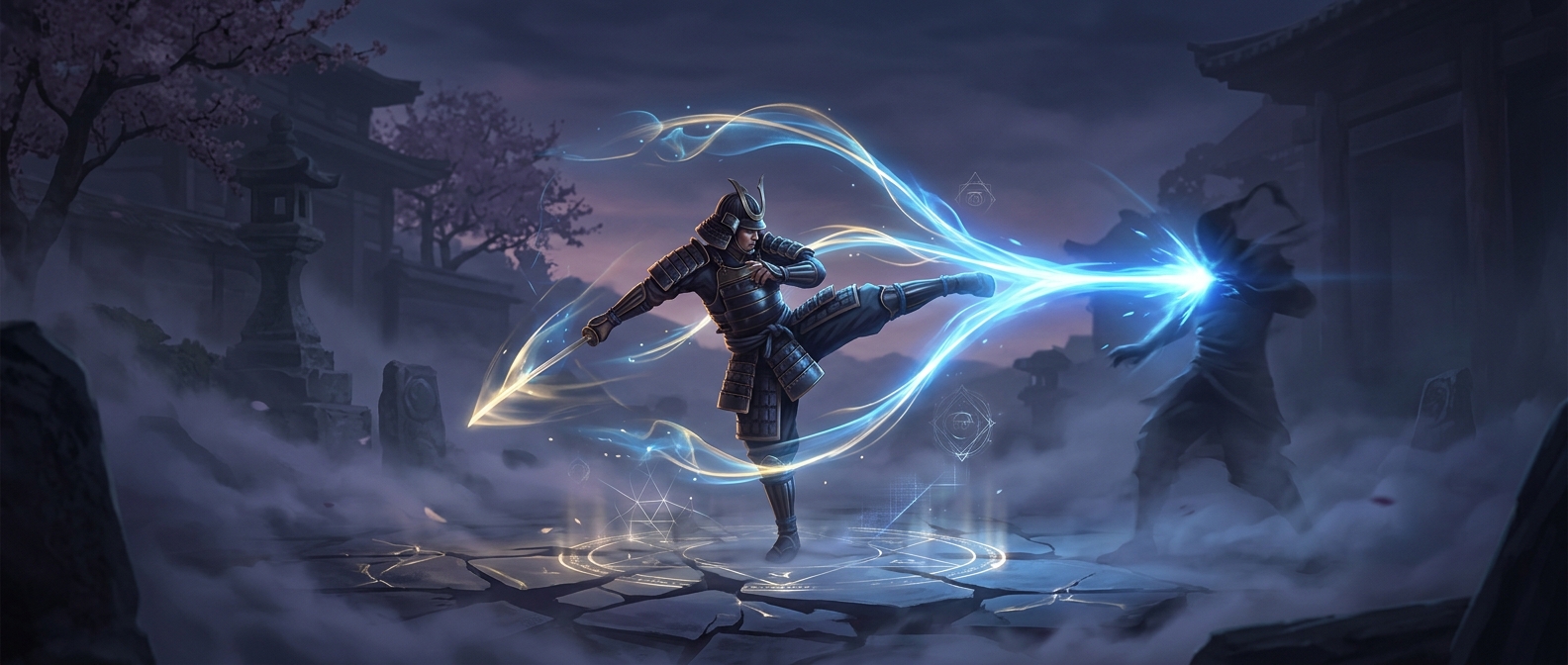
In many 2D fighting games, blocking is directional: the defender holds away from the opponent. A cross-up exploits a moment when that relationship changes. The attacker jumps over the defender, and the kick connects after the attacker has passed to the other side. The defender may still be holding the direction that was “away” a split second earlier—but now that direction leads into the attack.
The tricky part is that the defender usually cannot simply watch the kick’s animation and react. The crossing jump happens quickly, and the attacker can vary when the kick comes out or land without attacking. The defender has to judge where the attacker will be when the hit arrives and adjust their guard accordingly.
A Small Jump Creates a Larger Decision
This is a mix-up: an attack that makes the defender choose between plausible responses. A cross-up threatens a block in one direction, while an attack that lands on the original side may require the opposite direction. The attacker can also delay the strike, changing the timing and making an early defensive adjustment risky.
That choice is not always unavoidable. A defender who anticipates the jump may use an anti-air attack, move away, or choose another defensive option, depending on the game. But each response has its own risks, and reacting after the attacker has crossed may leave too little time to reset the guard.
The kick’s force comes less from damage than from making “hold away” an unreliable reflex. A brief passage over the opponent turns a familiar defensive input into a split-second question: away from whom, and at what moment?