A story built from gaps
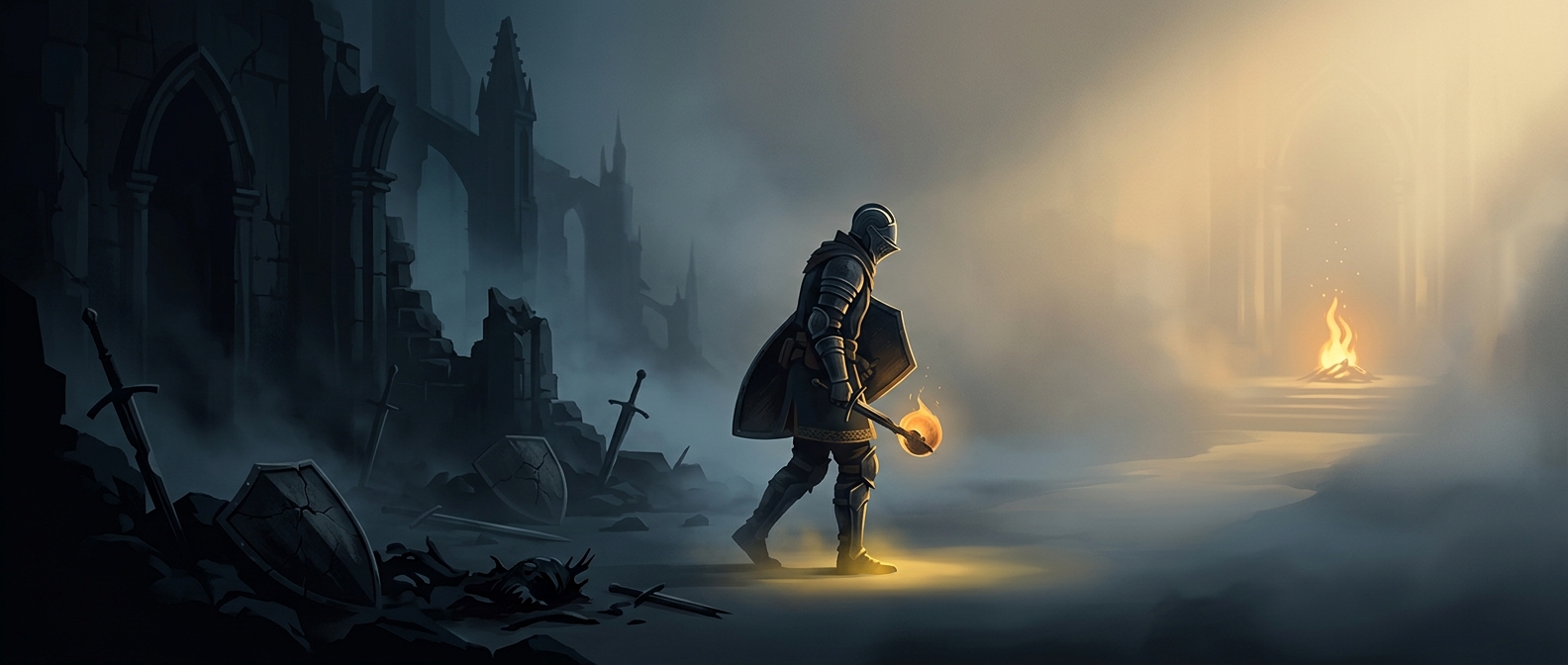
In Dark Souls, the past rarely arrives as a clean sequence of events. A character may offer only a partial account; an item description may name a person or conflict without explaining its place in the larger story. A ruined structure can suggest what happened there, but it does not supply a full account. The player has to connect these clues, and some connections remain uncertain.
That approach reflects a reading experience director Hidetaka Miyazaki has described from childhood: struggling with English fantasy books and imagining the parts he could not understand. The important creative step was not simply making a story hard to follow. It was turning the reader’s act of filling in gaps into part of the experience.
Clues make the player do the connecting
The game distributes information across different forms rather than relying on one narrator to explain its world. Item descriptions can provide a fragment of history; dialogue can reveal a character’s beliefs or limited perspective; the setting offers visible traces of earlier events. None is guaranteed to settle the whole picture on its own.
That structure changes the player’s role. Instead of receiving a complete explanation and then acting inside it, players gather details while exploring and form their own account of how those details fit together. The gaps are productive: they prompt attention and interpretation, much as the missing words in a difficult book once prompted Miyazaki to imagine what might be there.
Uncertainty becomes part of the mood
Because evidence is partial, players can disagree about what a clue means or how much confidence to place in it. The story feels old not because the game gives a comprehensive history, but because its surviving pieces seem incomplete. Understanding the world becomes an activity the player performs, not a service the game simply provides. Even after a long explanation, a fragment may still leave room for another reading.