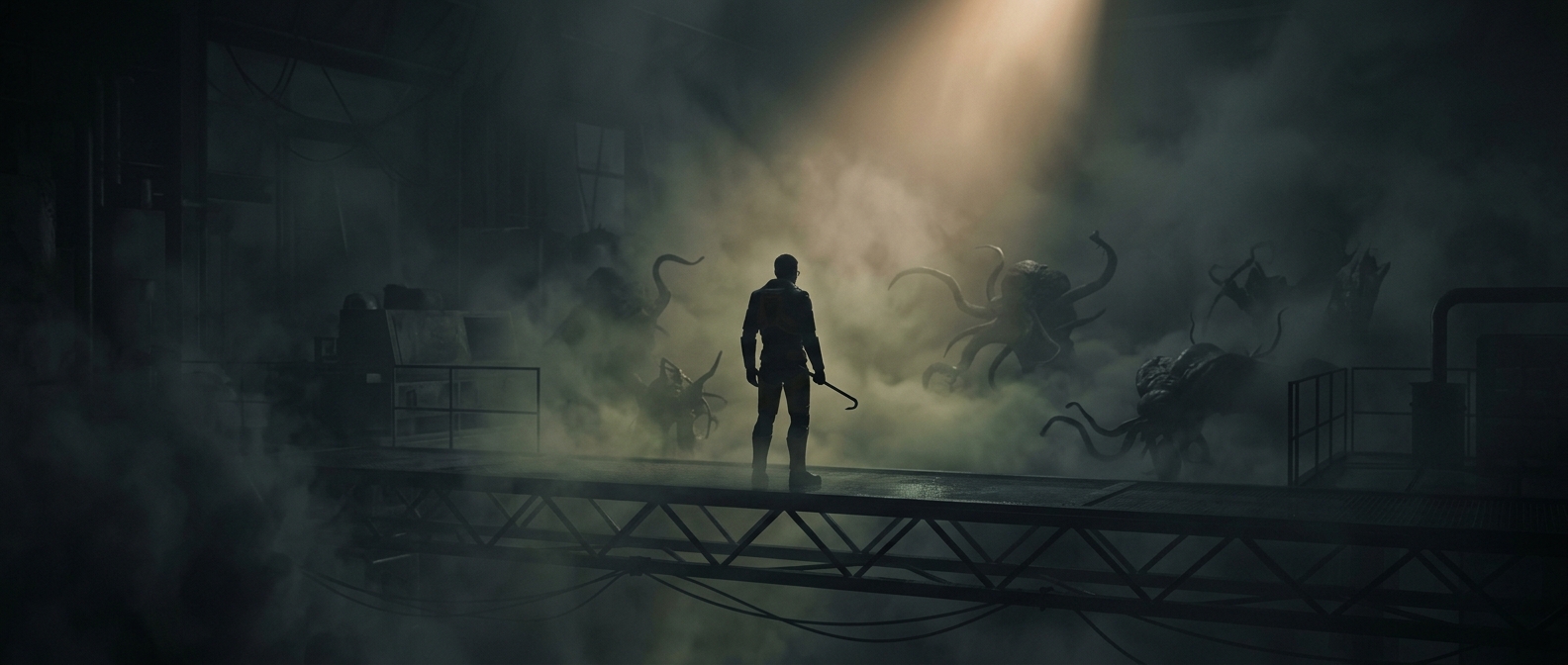
From Arrowhead to Quiver
Stephen King’s The Mist supplies a useful clue to Half-Life’s early identity. In King’s story, a military science project called Arrowhead opens a breach to another dimension, allowing strange creatures to enter the human world. Valve’s initial codename, “Quiver,” echoed that setup: a quiver is a container for arrows, making it a quiet wordplay on Arrowhead.
The connection is more than a shared monster premise. Both stories begin with a human attempt to investigate or manipulate forces beyond ordinary understanding, then turn the consequences into a physical threat. The experiment is not just backstory; it is the hinge that makes the strange invasion feel tied to a place and to choices people made there.
A nod, not an adaptation
Half-Life builds its own version of that catastrophe around the fictional Black Mesa research facility. A scientific test goes wrong, opening the way for creatures from another world to spill into the complex. The player experiences the disaster from inside, as Gordon Freeman, rather than watching events unfold from a safe distance.
That shift matters. King’s premise offers a potent engine for suspense—an unseen breach, unfamiliar life, and a human institution unable to contain what it has released. The game turns the engine into a playable sequence: corridors, laboratories, and service areas become spaces the player must cross while the experiment’s effects spread. “Quiver” preserves the literary wink, while the finished game transforms the idea into an interactive science-fiction disaster.