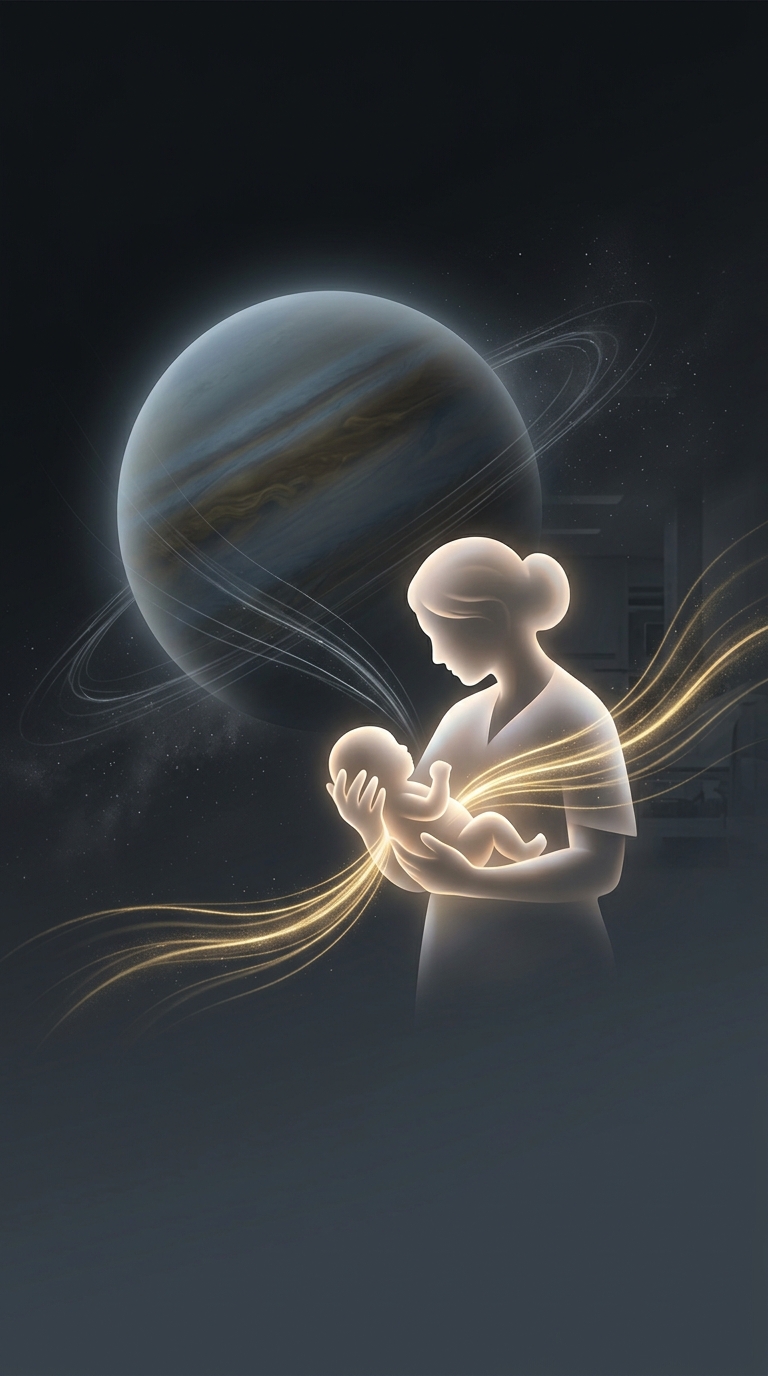
Distance Changes the Gravitational Comparison
Gravity depends on both an object's mass and its distance: double the distance, and its gravitational pull falls to one-quarter. That is why a person standing close to a newborn can exert more gravitational influence than many far-off planets, despite being vastly less massive.
But the comparison is not true for every planet in every configuration. Jupiter can pull more strongly than an individual clinician, because it is exceptionally massive and sometimes relatively close to Earth. The exact balance depends on where the planets are and how near the person is. The reliable point is that proximity matters—not that every nearby adult always outpulls every planet.
A Force Is Not the Same as an Astrological Influence
Gravitational attraction is a measurable physical interaction. Astrological claims about celestial bodies shaping personality or fate are different claims; they do not follow from the fact that gravity exists. A planet's gravitational pull does not encode a message about a newborn, and comparing it with a clinician's pull cannot test every possible astrological idea.
The comparison is useful because it makes distance tangible: a modest mass nearby can matter more gravitationally than a much larger one far away. But it is not a complete refutation of astrology. It shows that gravity alone cannot support the usual astrological story—and that Jupiter is an important exception to the catchy delivery-room version.